By Tom Warnke
What was is like here in Delray Beach five hundred years ago? There are actually places close by where you can see the “Old Florida” right now, and native trees are a beautiful part of that experience. As with the people of Delray Beach today, most of our trees are from elsewhere, but some are native, from descendants going back thousands of years. As a result, many of our local trees are friends, and some are less welcome.
This blog will include information about our early trees as well as trees brought here from around the world. They influenced the history of our area and helped shape what Delray Beach is today. Historians describe what has happened over time. Without making recommendations, I will include a history of some significant local trees.
Paradise Then and Now
On Easter 1513, Juan Ponce de León discovered Florida and saw the vibrant colors of our landscape. He had found a new land to conquer; a land he supposed had riches and resources to no end. He claimed it for Spain and gave it a Spanish name, “La Florida.” It was home to nearly 350,000 Native Americans comprised of more than two dozen tribes.
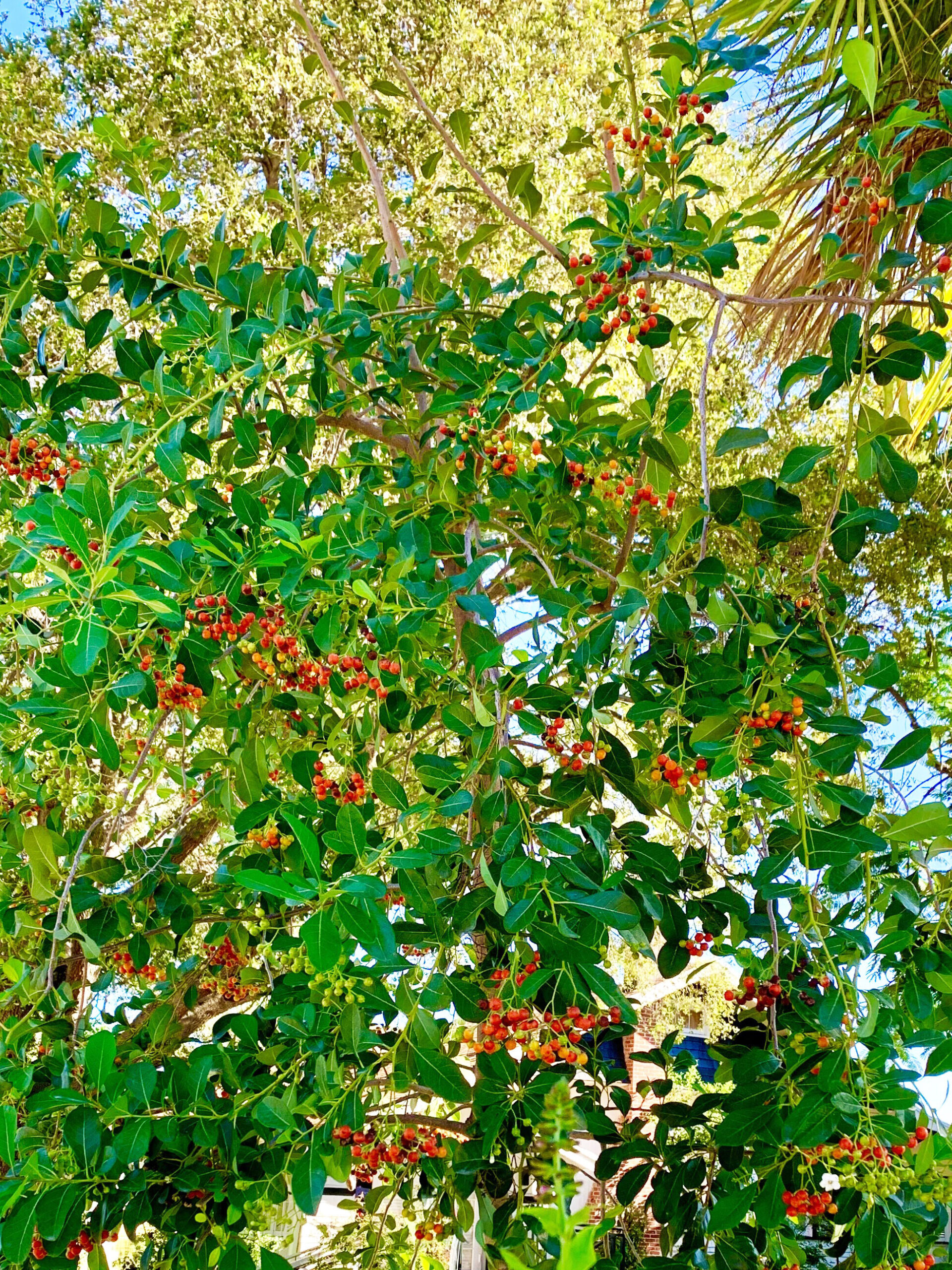
Examples of native trees in the Delray Beach area are palms, hardwoods, pines, and cypress. At least 60 native tree species! Our unique subtropical climate allows South Florida to have rare tropical hardwood species found nowhere else in the continental United States. Add to that many types of trees brought here during the past 130 years, and Delray’s landscape has been transformed into a “paradise” the first settlers would hardly recognize.
First Trees and First People
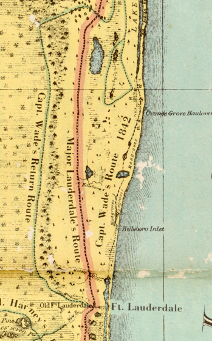
The oldest “place name” on maps in the Delray Beach area is “Orange Grove Haulover,” named for an acre of orange trees in a grove growing close to the beach, just south of where Atlantic Avenue is now. That orange grove was here in the 1860s and no one knows for sure who planted it. Early pioneer Charley Moore carved his name on one of those trees with the date of 1878. The Orange Grove Haulover was where the Native American Jaega (or Jeaga) tribe hauled their heavy cypress canoes between the ocean and an ancient creek. That deep, wooded creek was just west of the dune, about 100 yards east of where the Intracoastal Waterway is now. That creek was probably here for thousands of years.
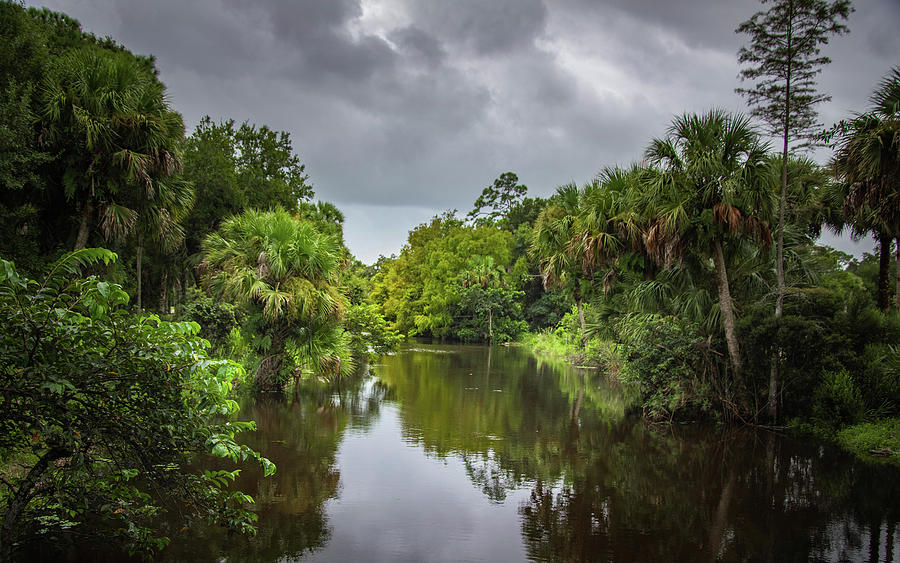
Those same Native Americans, long before the Seminoles, lived under the trees in the coastal dune hammocks and hardwood hammocks along the coast. The trees provided good shelter from the sun and wind, and the navigable creek had a tree canopy for much of its winding course from behind the local haulover, all the way to the Boca Raton Inlet. This creek was called Indian Creek and was later named Spanish River. In 1894, when the Intracoastal Waterway was dredged from Boynton to Boca Raton, just west of the creek, the creek dried up and disappeared.
When a forest reaches its maximum height, it is referred to as a “climax forest.” This is true of the coastal dune hammocks and hardwood hammocks along our oceanfront. A climax forest can remain in a relatively balanced state for centuries. The surviving coastal hammocks you can visit right now are: Ocean Ridge Hammock Park on highway A1A adjacent to Boynton Beach Oceanfront Park, the John D. McArthur State Park on Singer Island and Hugh Taylor Birch State Park in Fort Lauderdale. All three are worth visiting to see what a fully-grown coastal forest was like 1,000 years ago. Even on a windy day, those forests along the beach provide good protection. They can include sea grape, mahogany, strangler fig, gumbo limbo, buttonwood, mastic, wild tamarind, large-leaf clusia (aka pitch apple) and pigeon plum, plus 200 other species of native plants and animals. Ancient pottery, tools and burials are often found at these sites. They were left here 500 to 1,500 years ago by the native Jaega and Tequesta peoples. Ancestors of those tribes hunted mammoth and mastodon here 12,000 years ago, but that is a story for another time.
Mystery Orange Grove and the House of Refuge
The orange tree with “Charley Moore, 1878” carved on it was part of Delray for many years. It was still there in 1902. Charley arrived here a few years earlier when he came ashore in a life raft. He was a seaman who jumped ship, fearing he would be arrested for an on-board fight. Mr. Moore homesteaded alone on the desolate barrier island where Palm Beach is now. In 1872, Hannibal Pierce moved here with his family. They were the first homesteaders on the Lake Worth Lagoon, making their home on Hypoluxo Island. Hannibal Pierce was then hired as the first keeper of the Orange Grove House of Refuge. It was built to help save shipwrecked sailors, located east of the dune, just north of where Atlantic Avenue is now. Hannibal, his wife Margretta and their son Charlie were the first non-natives to live in the Delray area. At the time, there were bears, panthers, and Seminoles frequenting those woods on the dune overlooking the ocean.
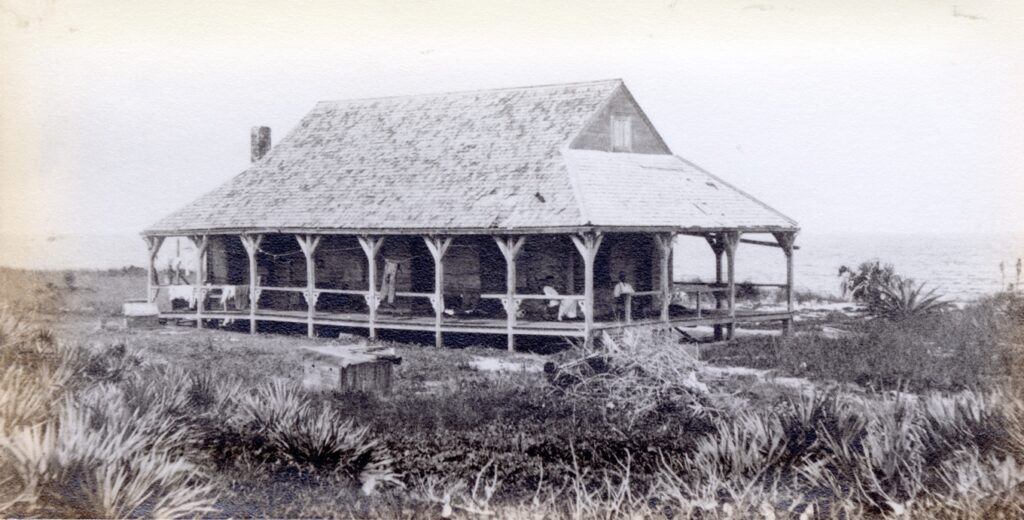
When Pierce family moved back to Hypoluxo Island (five miles north of the House of Refuge), the only way for them to travel was to sail on the ocean or walk the beach. Their home on Hypoluxo Island had a very large banyan tree just outside their front door that provided shelter. It may still be there, since there is a banyan tree on that site right now which is possibly that old. Banyans often live for hundreds of years.
Today on Ocean Avenue in Boynton Beach, there are a few banyan trees at least 100 years old. Where is the oldest tree in Delray Beach? It may be a royal palm, a banyan, or a mango. Locating it has yet to be accomplished.
Mangroves and sabal palm trees, part of Delray’s flora for thousands of years, were growing along the “canal” when the first settlers arrived by boat. This was one of the first impressions they had of our area.
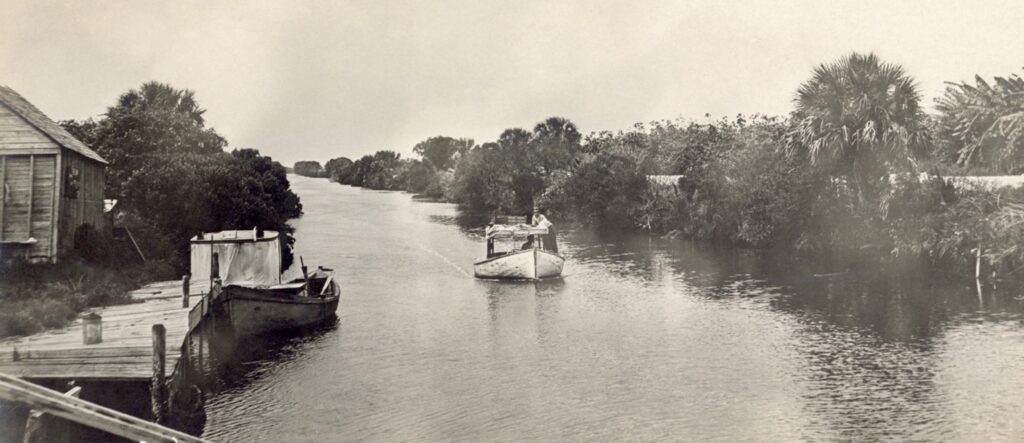
Those mangrove trees harbored swarms of mosquitoes and no-see-ums, making life near the salt water almost unbearable. Insects and crabs are food for the fish that hide among the famous mangrove roots, constituting one of the most important ecosystems in the world. Mangrove trees are the nursery area for our inshore and offshore fisheries that help drive our local economy. Without our mangrove trees that fishery would collapse.
Trees on the High Ground in Delray
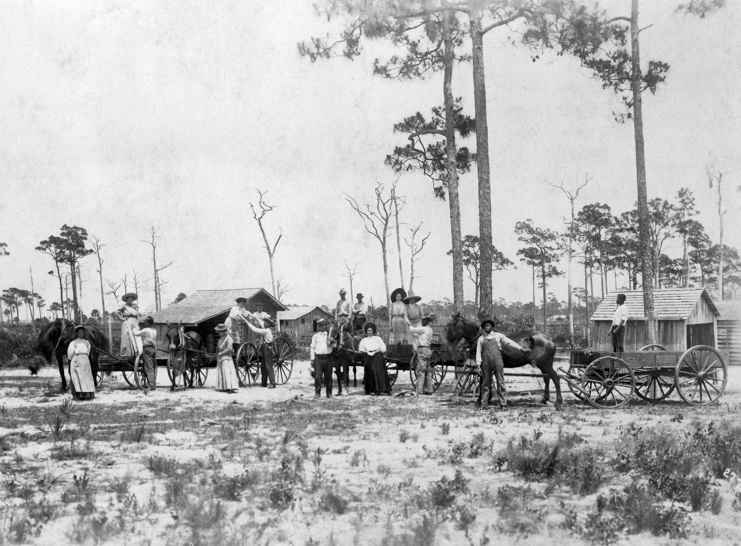
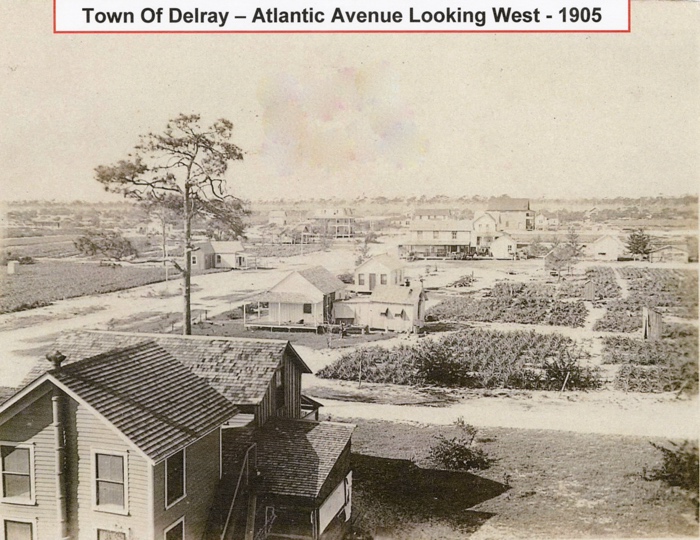
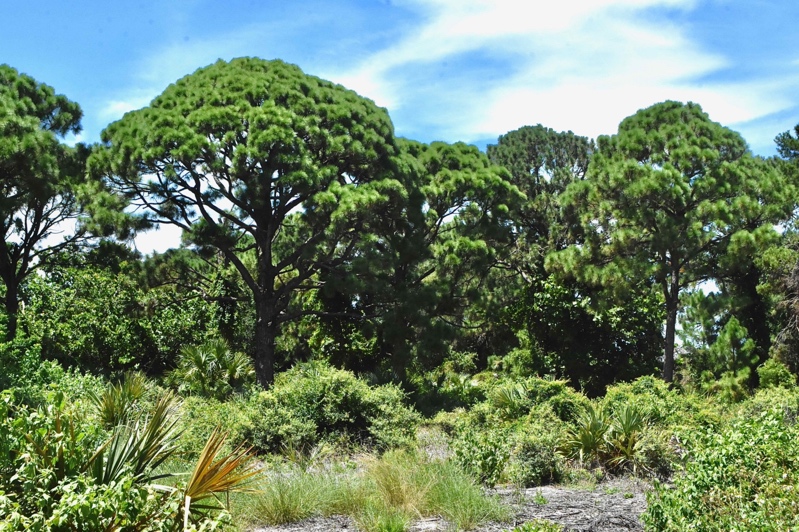
A short way west of the coast, pine trees were on slightly higher land with just enough elevation to avoid long-term flooding. This area was chosen for camping and eventual homes. As viewed by the pioneers, this treescape was sparse slash pines with a few scrub pines. They grew in the white “sugar” sand and provided a bit of shade for the palmettos and scrub oak. This was rattlesnake territory, populated with rabbits, bobwhite quail, fox, deer, and bears. The first pioneers settled in those pine woods to avoid the marshy areas to the east and west.
Wood for Pioneer Homes
Without any sawmills for 100 miles, building a home here before the 1890s often meant waiting for bad weather. Storms regularly caused lumber ships to wreck, casting their free cargo onto the beach, including structural timbers and large quantities of other lumber. The local cabbage palm trees provided fronds for the first roofing, as ships rarely transported shingles.
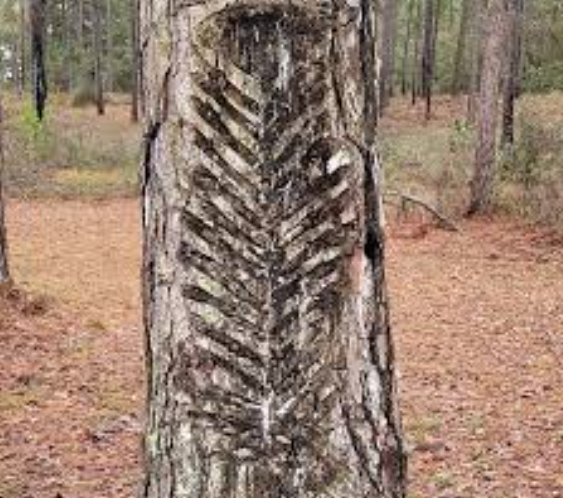
Local pines were sparse because most had probably been cut down for “Naval Store” products, critical for use during the U.S. Civil War. Those pines were also used for lumber. By tapping a slash pine using a “Cat Face” cut, and hanging a terra-cotta pot from a nail, settlers collected the pine sap that oozed into the pot to produce turpentine, varnish, and indispensable pine tar sealants for ships.
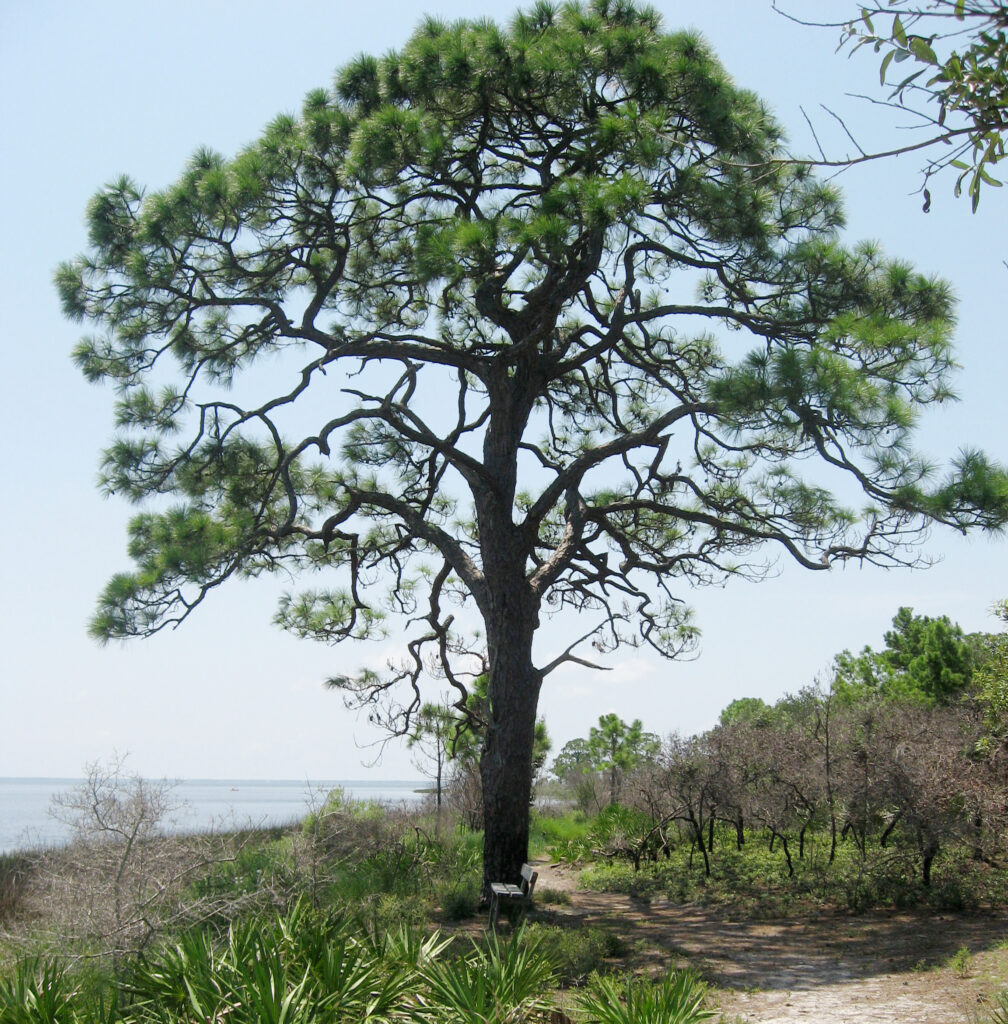
Heartwood of mature slash pines became the famous, slow-growing “Dade County Pine.” It was preferred for constructing homes and businesses because it was very hard, and because termites would not eat it. That heartwood contained so much sap it was called “starter pine” or “lighter knot.” Small bundles of it were carried by campers and hunters to start campfires. In the early 1900s, Delray was part of Dade County, which extended north past Jupiter. All three historic homes at the Delray Beach Historical Society were constructed using Dade County Pine. The termites have had their chances for more than 100 years. These buildings have also survived more than 100 years of hurricanes.
Those Trees that Survived
Today’s remaining slash pines deserve to be protected; however, their 20-foot deep tap roots can be starved for water as the aquifer is lowered via municipal wells, golf course wells, and rock mines. Pine trees lacking water from the surficial aquifer are slowly stressed, inviting bark beetles to invade and kill the trees. A lowered water table, however, is often the first step. An average golf course uses three million gallons per day, or 100,000 gallons of water per round of golf. Wells that are miles away from pine trees can still cause those trees to die of thirst.
Cabbage palm trees, also known as sabal palms, were used for food. The sabal palm is the official State Tree of Florida. Settlers harvested the heart of the new growth and called it Swamp Cabbage – now referred to as Hearts of Palm.
Lake Ida, named by William Linton for his wife, had wooded areas on its shores. The lake probably dates back thousands of years. It now only partially resembles the way it was 100 years ago. Early descriptions were that it was much larger and mostly a shallow marsh.
In between the marshy area of Lake Ida and the Everglades, the slightly higher pine forest was used by the U.S. Military for their wagons and troop movements during three wars with the Seminoles in the 1800s. No treaty was signed, and the U.S. government allowed the last of the Seminoles to retreat to the cypress forests west of the Everglades. Today’s Military Trail, in the same location used by those U.S. soldiers as a wagon trail, is now ten lanes wide.
Cypress versus Melaleuca
Cypress trees have one of the most compelling histories. They constitute the headwaters of the Delray Beach watershed, both for surface water and underground water. That watershed flows from the cypress swamps located far west of Delray, directly to the ocean, most of it underground. It is known as the Florida Aquifer. The volume of underground water movement via the aquifer to the ocean in Palm Beach County far exceeds the amount that flows on the surface to the ocean via our four inlets, two magnitudes more.
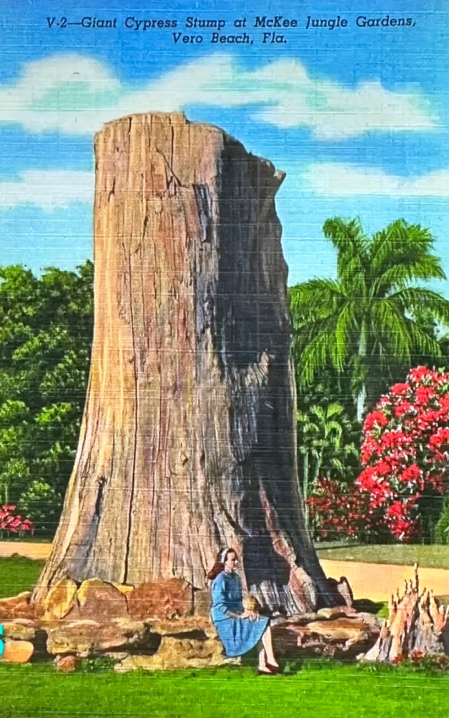
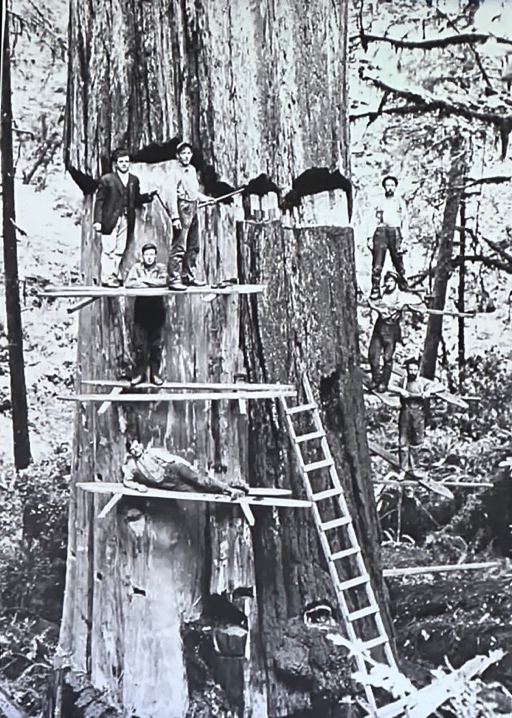
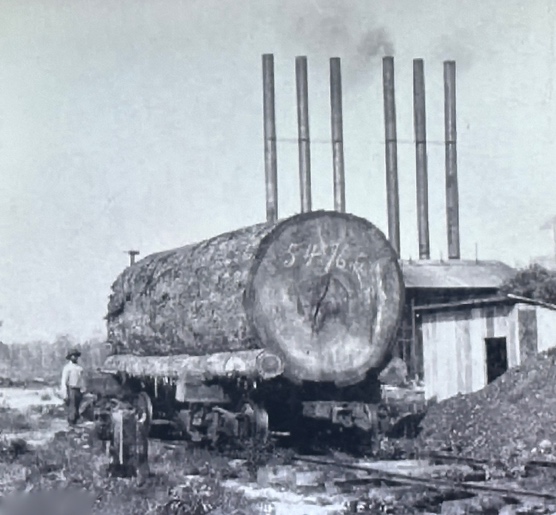
More than 90 percent of the mature cypress in South Florida was logged off 100 years ago, leaving just a few old-growth trees. Some of the last remaining old-growth cypress were saved in the Corkscrew Swamp preserve, two hours west of Delray Beach. Cypress trees were not present along the coast in the Delray area when the first settlers arrived, but there were many large cypress trees near Jupiter, and very large cypress trees in the Vero Beach area as far east as the present-day US-1 highway.
Related to redwood trees, cypress are the only deciduous conifers, so they appear to be dead in winter. Unlike pine and other forests, a cypress forest is almost impossible to replace. Yet some southeastern states allow clear-cutting of cypress forests for mulch. Its reputation as mulch for repelling bugs is unfounded because only the old-growth heartwood has that property. Melaleuca mulch is a great alternative.
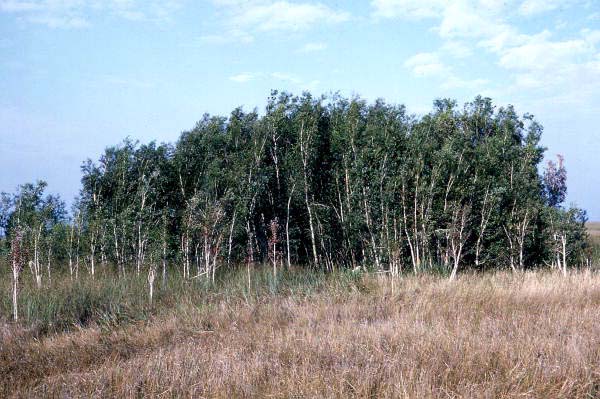
Speaking of melaleuca (also known as the “punk tree”), this smelly invasive tree has the most irritating pollen hereabouts. It grows in standing water or on land, taking over cypress and other forested areas. Scorpions love to live under its papery bark. Melaleuca is an Australian tree and was planted here to help “drain the swamp.” It has now displaced thousands of acres of native South Florida forests. We taxpayers are now paying to remove it.
Lessons Learned
The other non-native Delray Beach trees worth mentioning are the Australian pine, Norfolk Island pine, and the coconut palm. The Australian pine (Casuarina) can attain a height of more than 100 feet and forms dense thickets, crowding out native plants. Like some other invasive plants, it also produces compounds which prevent other plants’ seeds from germinating. Australian pine contributes nothing to native animals and destroys natural habitat by producing “monoculture” thickets. They were used in landscaping and as effective cold weather windbreaks.
Norfolk Island pine trees also have a propensity for harm, and in most municipalities, neither Norfolk Island pines or Australian pines are allowed in new landscaping. Norfolk Island pines are sold as cute, tiny Christmas trees by the thousands to unknowing customers. When planted they become giant eyesores. Large ones can have trunks three feet in diameter, composed of wood with white sap. Chain saws have a difficult time cutting through it, and it can cost thousands of dollars to remove a big one. Both these pines, along with the Melaleuca, are listed as Class 1 Invasive trees by the State of Florida. Willow trees, acacia trees, and Brazilian pepper are also highly invasive.
Coconut trees were very uncommon here before the 1870s, but ships loaded with thousands of coconuts from the Caribbean, headed for northern ports, often wrecked here and those planted nuts gave Palm Beach its name. Arguably the most photogenic and tropical-looking palm, coconut palms also bring the need for frequent trimming in pedestrian areas, and don’t provide much shade. Millions were killed in the “lethal yellowing” blight in the 1970s. As a result, we see fewer coconut palms today, but there are still thousands in Delray. Most are not the “Jamaican Tall” species, since other varieties were less susceptible to the blight. Any remaining Jamaican Tall coconut trees in Delray are worth special care. Coconuts becoming dangerous cannonballs in hurricanes is only true in the most severe storms. When blown off in a hurricane, they usually fall very close to the tree.
A few native trees that thrive in the Delray area but were not common in pioneer days are tamarind, cedar, magnolia, cypress, royal palms, mahogany, paurotis palms, and large leaf clusia trees. Today, there is significant interest in planting them because of their low maintenance, drought tolerance, and beauty.
Picturesque Atlantic Avenue
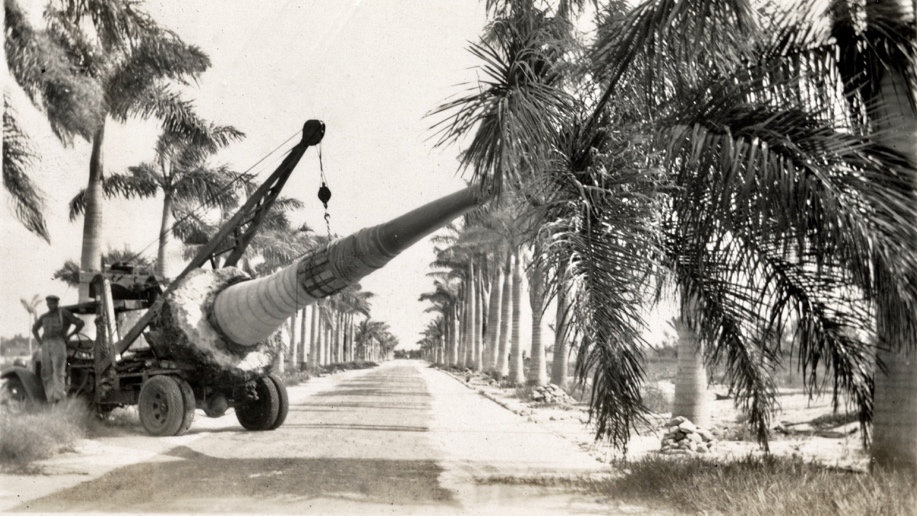
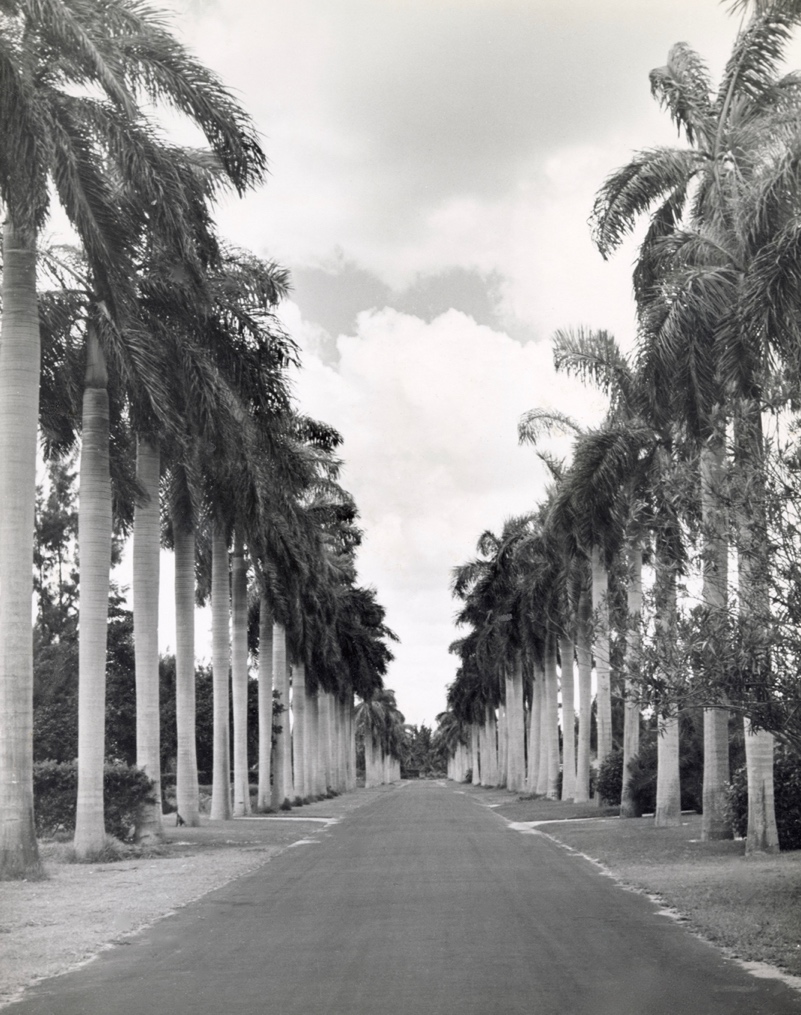
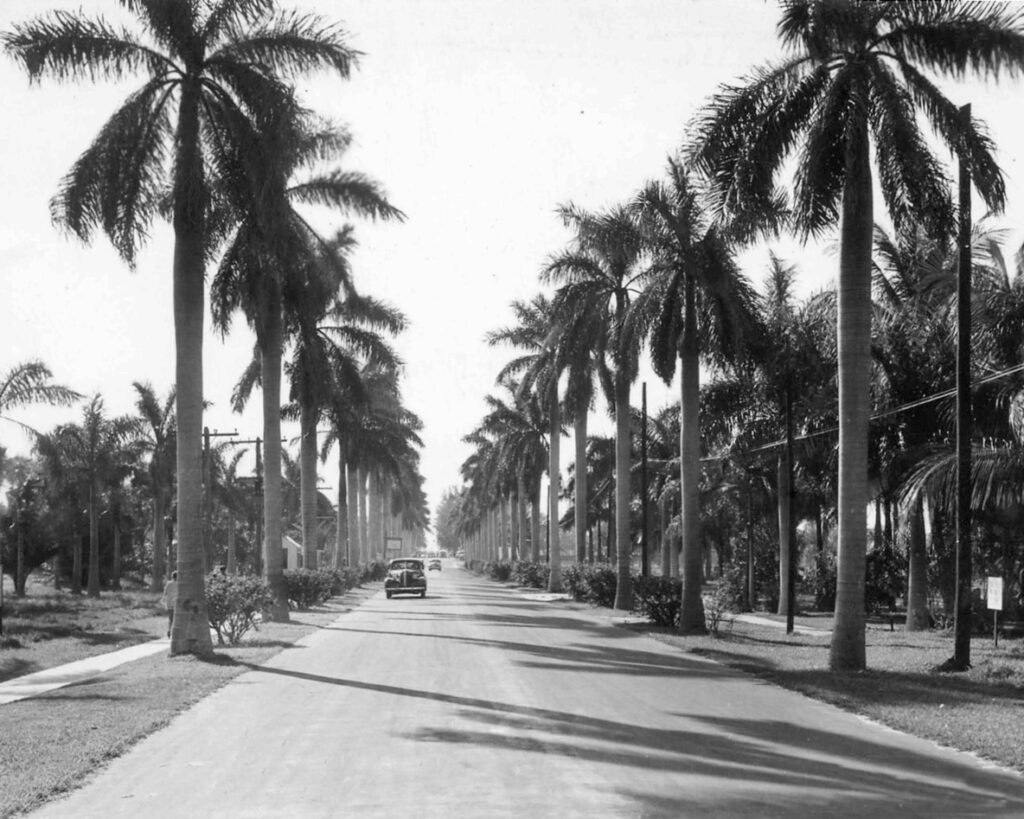
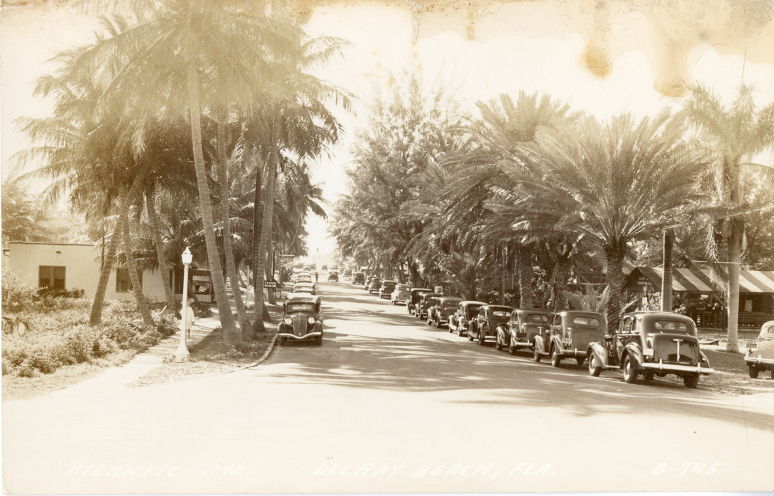
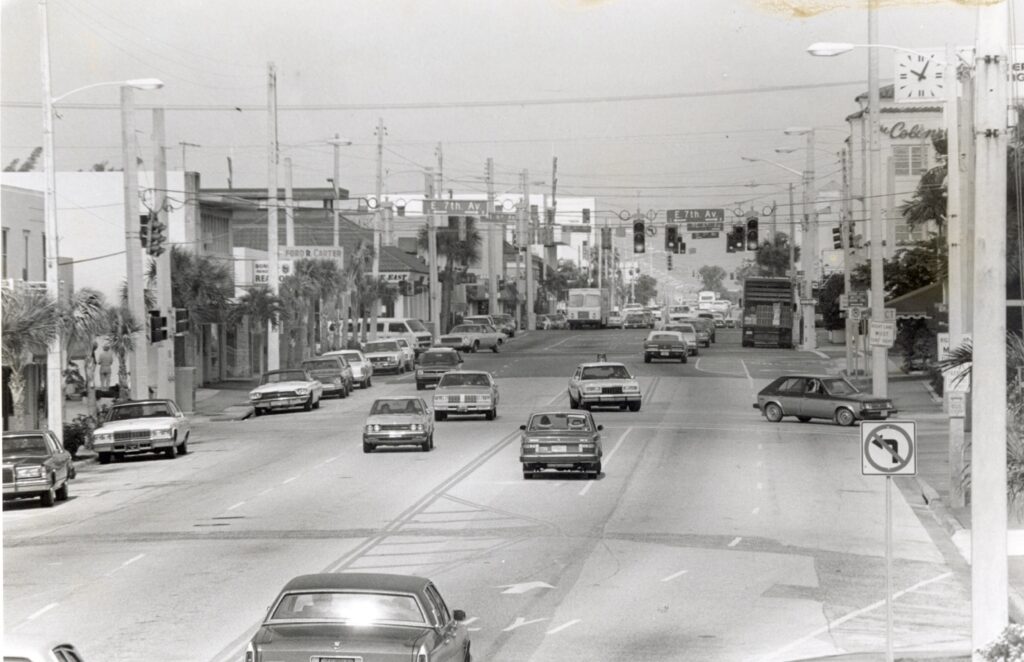
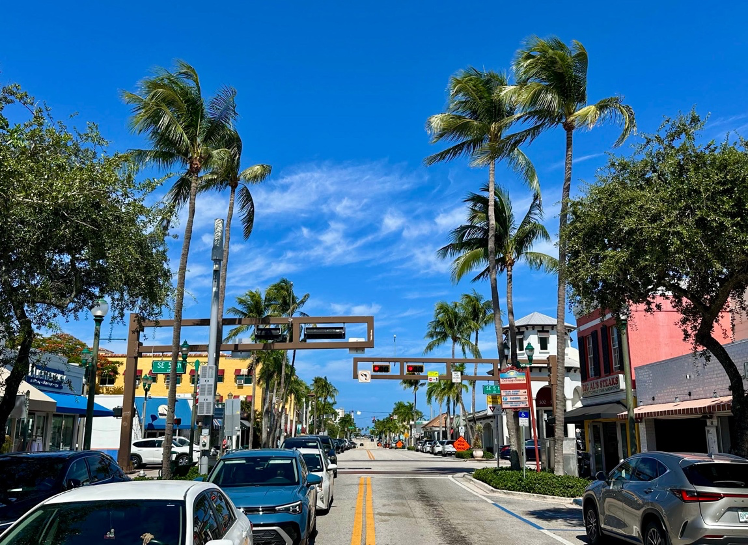
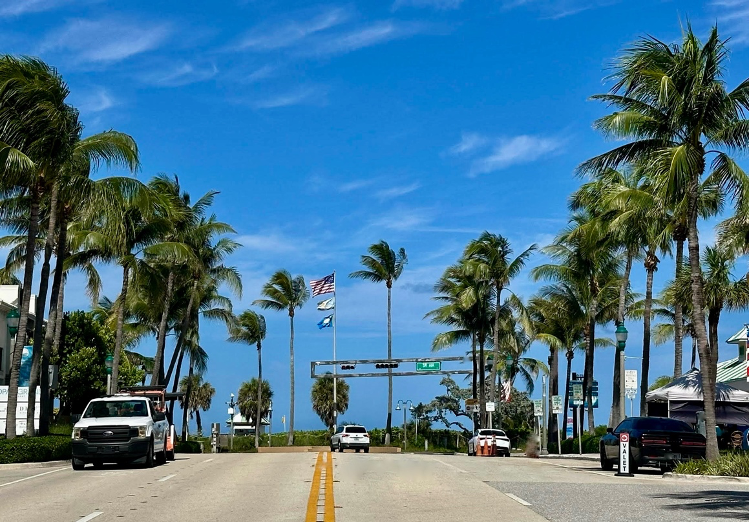
Atlantic Avenue’s trees have been depicted in postcard photos for more than 100 years. Native sabal palms were replaced by Australian pines and then coconut palms to line the avenue from the bridge to the beach.
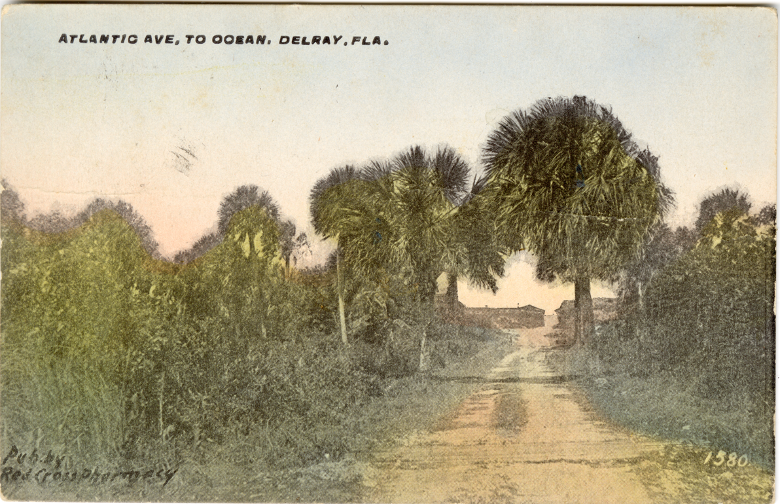
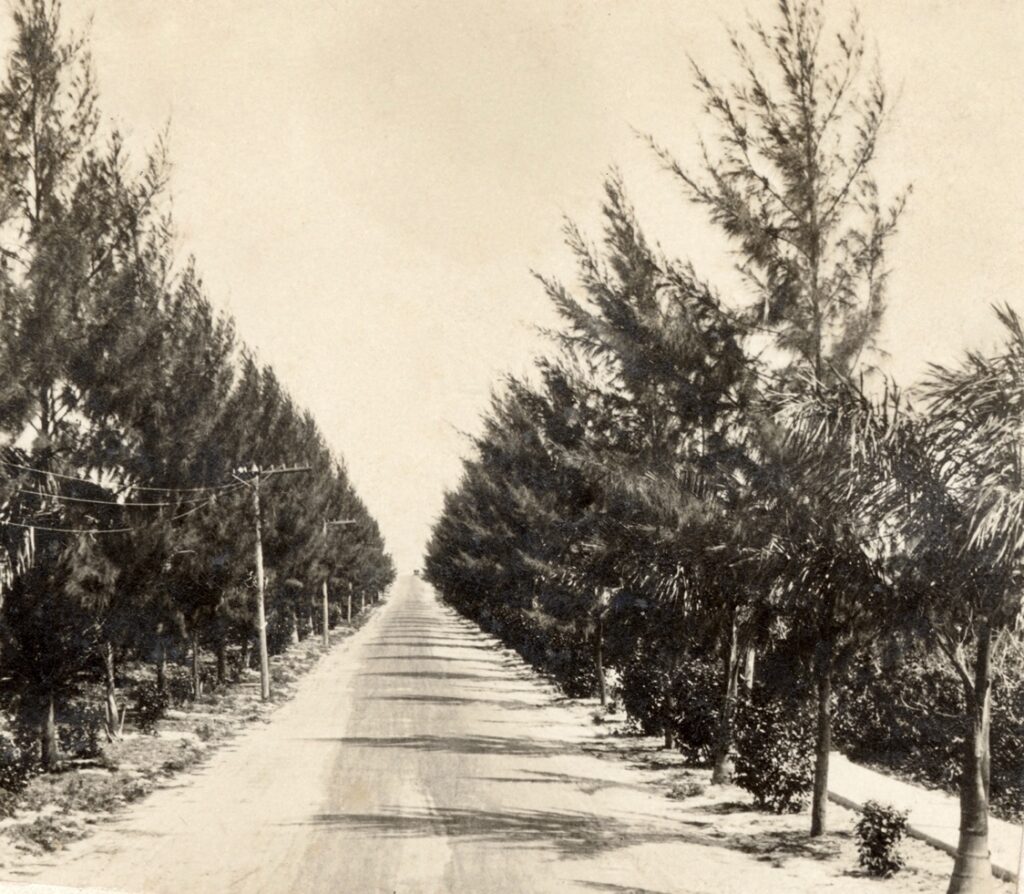
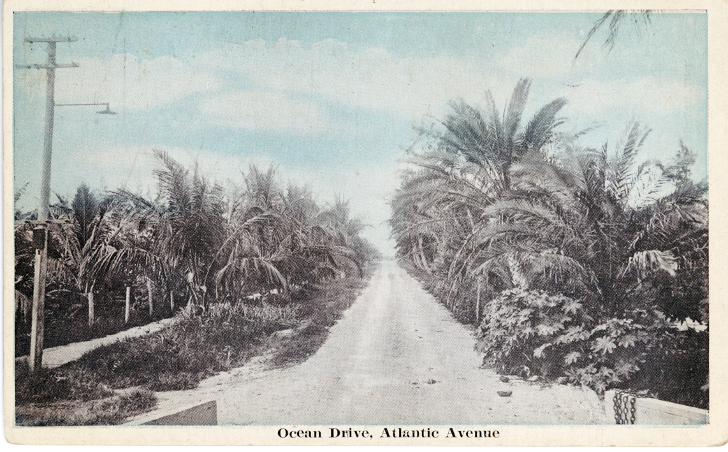
In the 1920s, native royal palms replaced most of the coconut palms. The royals were from the Mike Blank Palm Tree Nursery along the waterway just to the south. At that same time, the royal palms on Seabreeze Avenue were installed by Adolf Hofman, just northeast of the bridge. Those are now over 100 years old and as beautiful as ever.
Delray’s Edible Landscape
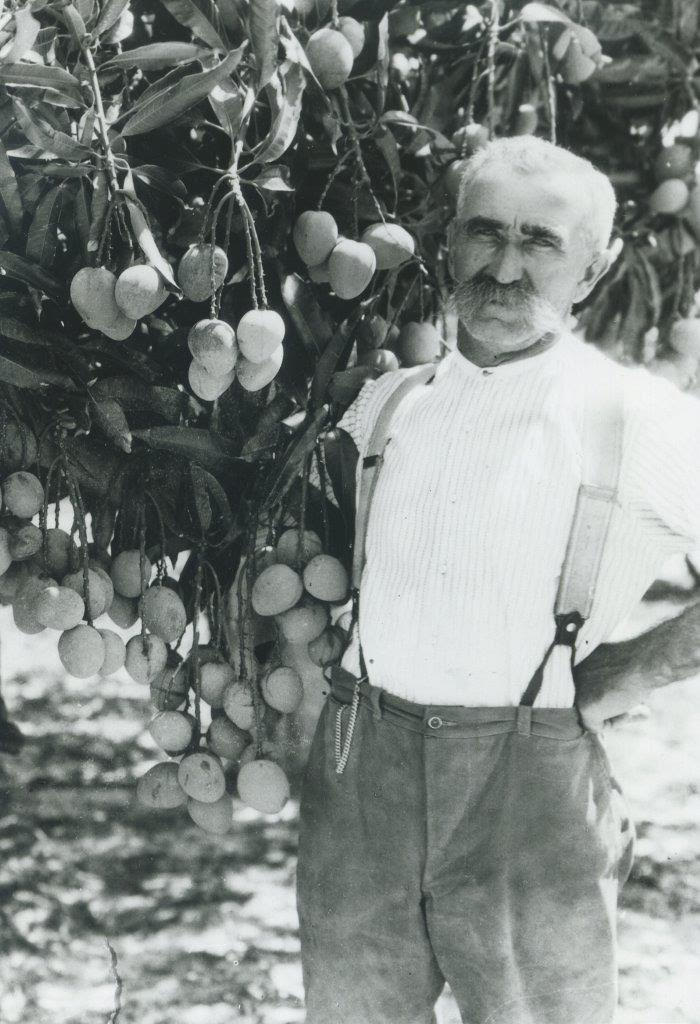
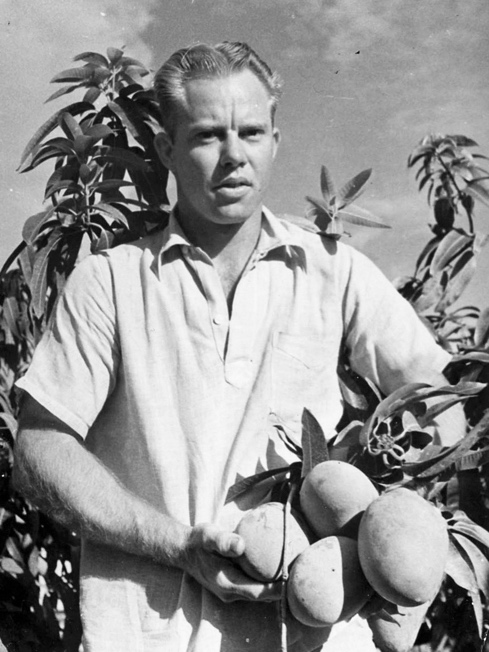
Tropical fruit trees and citrus trees thrive here. Mangos are now the most prolific. Delray’s first mangos were probably planted by Adolf Hofman at the end of the 19th century. He also planted citrus and other fruit trees. The Zill family of Delray then became famous for cultivating new varieties of mangos. Both families’ collections have a special place in the Archives at the Delray Beach Historical Society, where there is now a Zill mango tree bearing fruit. Delray Beach was where the mango daiquiri was invented at a beach bar in the 1940s. Orange trees have been growing in Delray for more than 160 years. A notable citrus grower here was Blood’s Hammock Groves. It was also a tourist attraction with tours highlighting the simultaneous ripe fruit and fragrant blossoms. The last known Hofman mango tree was on North Lake Trail, still bearing a crop every year after more than 100 years. It was removed in 2025.
Two Sidebars: Australian Pines and Banyans
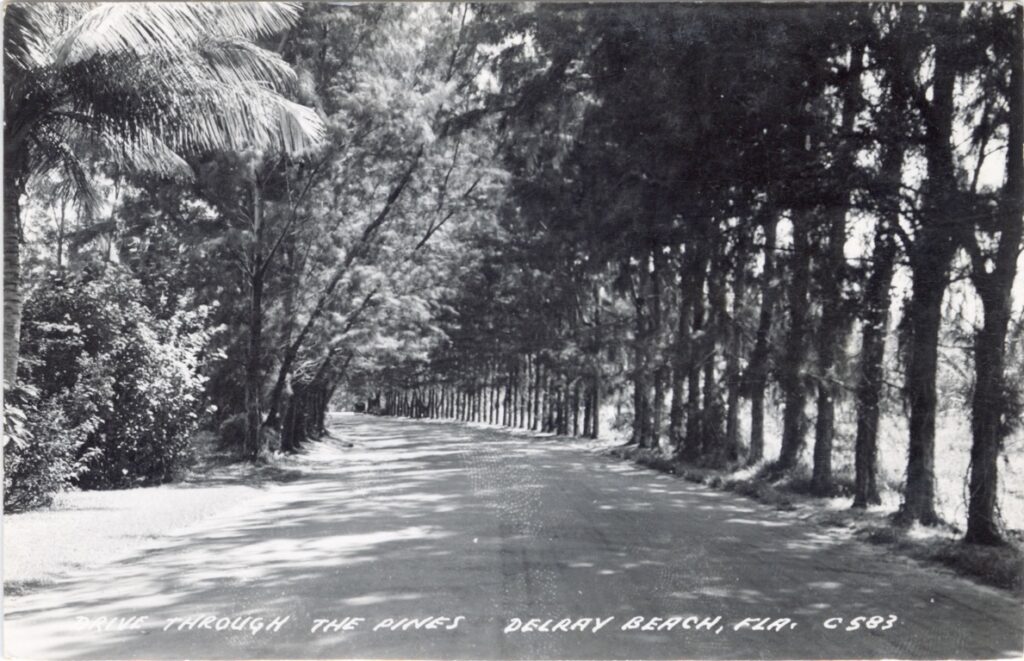
After providing a picturesque drive for more than 100 years, the Australian pine canopy road along A1A just north of Delray was designated as an historic landmark. The designation preserved the trees, but was controversial because it prevented any widening of the roadway or the addition of bicycle lanes.
In 2026, the City of Delray Beach was required by the Lake Worth Drainage District to remove a giant banyan tree from a canal bank as part of the city golf course renovation. Many Ficus trees, of which there are more than 800 species, have shallow roots. Ficus with smaller leaves, such as Ficus benjamina trees, grow almost as large as banyans and can become uprooted in tropical storms. However, banyan trees have much larger leaves. They are from India where they have evolved with hurricanes and monsoons over eons. As a result, banyans survive by losing their leaves in high winds. Instances of large banyans tipping over have rarely been documented.
Where to Go Today to See Old Florida and its Trees
Ocean Ridge Hammock Park. On Highway A1A five miles north of Delray Beach. This park has free limited parking, but it can also be accessed from the adjacent Boynton Beach Oceanfront Park to the south. The footpath from A1A though the center of this forest to the beach has an excellent view of the overhead canopy of mature hardwoods. If you visit, stop along the path and visualize what it was like living under those trees as a member of a First Nation tribe 1,000 years ago. This is a very typical living site for Florida’s first tribes, protected from the elements. In fact, a Jaega tribe living site and mound is located just to the north, now under a condominium. This living site is also where a canoe haulover at the south end of the Lake Worth Lagoon existed for millennia.
John D. McArthur Beach State Park. Riviera Beach. This large park includes an intact coastal dune hammock at the east end of the popular boardwalk to the ocean.
Seacrest Scrub Natural Area. Only ¼ mile north of Delray on Seacrest Boulevard. Free parking and an excellent example of mature slash pines, scrub pines, and unique scrub habitat. Controlled burns enable the scrub pines to reproduce.
Loxahatchee National Wildlife Refuge. West of Delray on US-441. Three areas of this park include trees of note. The boardwalk and interpretive center showcase an authentic “cypress head.” This is a swamp; distinguished from a marsh because swamps have trees. Nature trails through the adjacent marsh include numerous wading birds and alligators, as does the expansive view from the flood control dike overlooking the Everglades with cypress tree islands in the distance.
Caloosa Park. Just north of Delray on Congress Avenue. Beyond the soccer fields and ball courts, the north end of this county park has a beautiful area of large slash pines with free parking in their shade. It was named for the Native American Calusa tribe headquartered in the Ft. Myers area. The Calusa were the most dominant tribe in South Florida for more than 1,000 years.
Loxahatchee River. This Palm Beach County park west of Jupiter (30 minutes north of Delray Beach) allows visitors to experience a “wild and scenic river.” It was designated as such in 1985 and was Florida’s only river with this federal designation until the Wekiva River in Central Florida was designated in 2000. Rent or bring a canoe to see the towering cypress, pines, palms and mangrove trees. The Loxahatchee River is a day trip by canoe, kayak or paddleboard, down the narrow, meandering river; similar to the winding, shaded, deep creek that ran from Delray to the Boca Raton Inlet for many hundreds of years.
Trees of the Delray Beach Historical Society
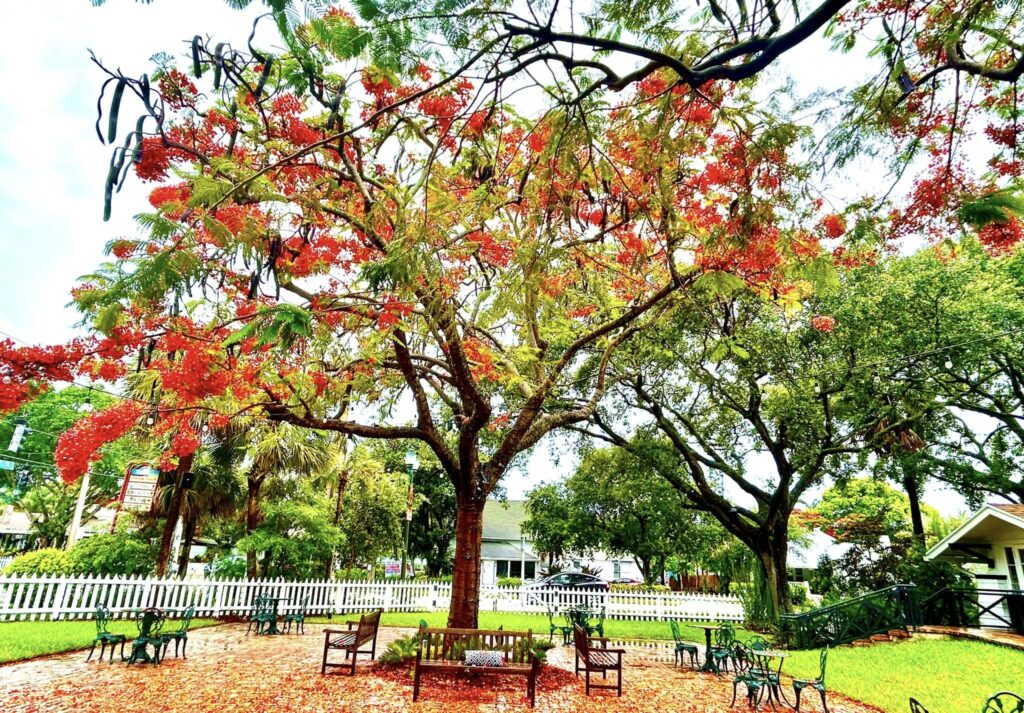
Today, you can enjoy a shaded tree canopy in our Heritage Gardens in downtown Delray Beach. A full acre of lush native plants and trees in five distinct habitats is open to the public for self-guided tours seven days a week. The educational garden includes signs with the scientific names and common names of over 200 native Florida plants. Native Florida trees in the garden include thatch palm, royal palm, silver palm, sabal palm (the Florida State Tree), paurotis palm, gumbo limbo, slash pine, and oak.
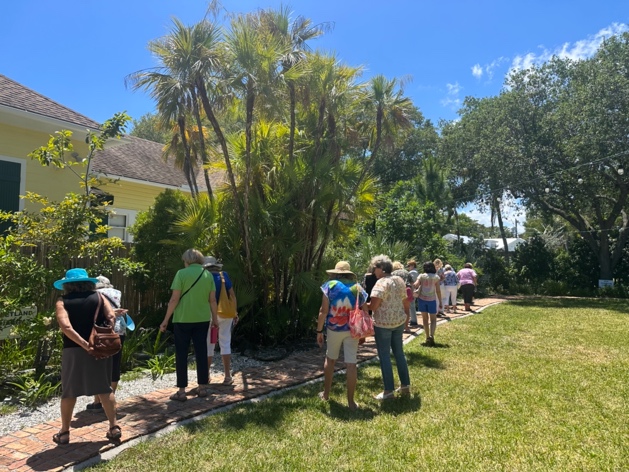
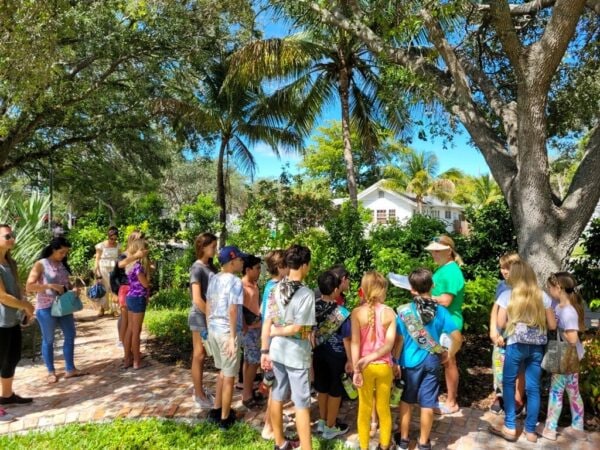
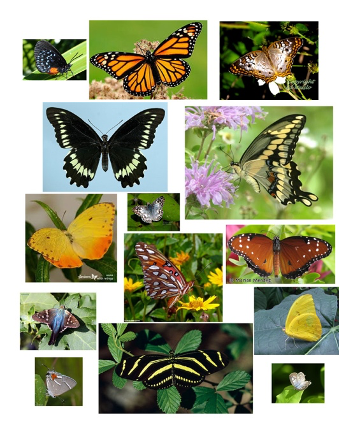
Installed by the Delray Beach Historical Society in 2017, this somewhat-hidden native plant garden is an immersive experience made possible by the Grass River Garden Club, with design and planting help from Carl Terwilliger of Meadow Beauty Nursery in Lake Worth. It is maintained by a dedicated group of volunteers, including several Master Gardeners. Other trees include mature royal poincianas, an endangered Florida native Bahama strongbark, a Hercules’ Club tree, a starfruit tree, a pond apple tree, and our Zill mango tree. Butterflies abound due to the native plants, such as Atalas (once thought to be extinct), Zebra longwings, Monarchs, and Black swallowtails.
Delray’s Tree Canopy Program
Trees are critical green infrastructure that provide valuable services including stormwater management, reduction of the heat island effect, wildlife habitat, oxygen production, reduced air pollution, and carbon sequestration. All these things have economic benefits, not to mention increased property values.
To quantify the benefits and better plan where trees should be planted, the City conducted a Tree Canopy Analysis in 2019. It is available on the city website, along with the city’s Urban Forest Management Plan. The report determined that Delray Beach’s canopy had an average of 23% coverage, with some neighborhoods maintaining 29% canopy and others as low as 15%. The report recommended establishing a goal of 10,000 new trees in five years to raise the average canopy to 28%, reducing the disparity among neighborhoods, maintaining the health of the current urban forest through proactive maintenance and increasing staff training.
An inventory of all the trees on city property was conducted and a report of this data, along with an Urban Forest Management Plan, was completed. The Tree Inventory and the UFMP provides background information useful in caring for existing trees and identifying remaining planting locations on City property.
In 2020, the City adopted the “10,000 Trees by Year 2025” goal. By the end of the first year of this goal, the City had planted 300 new trees in parks, 250 trees at local schools, 200 trees in rights-of-ways, and gave away 1,000 trees to residents. The project was substantially completed in June 2021.
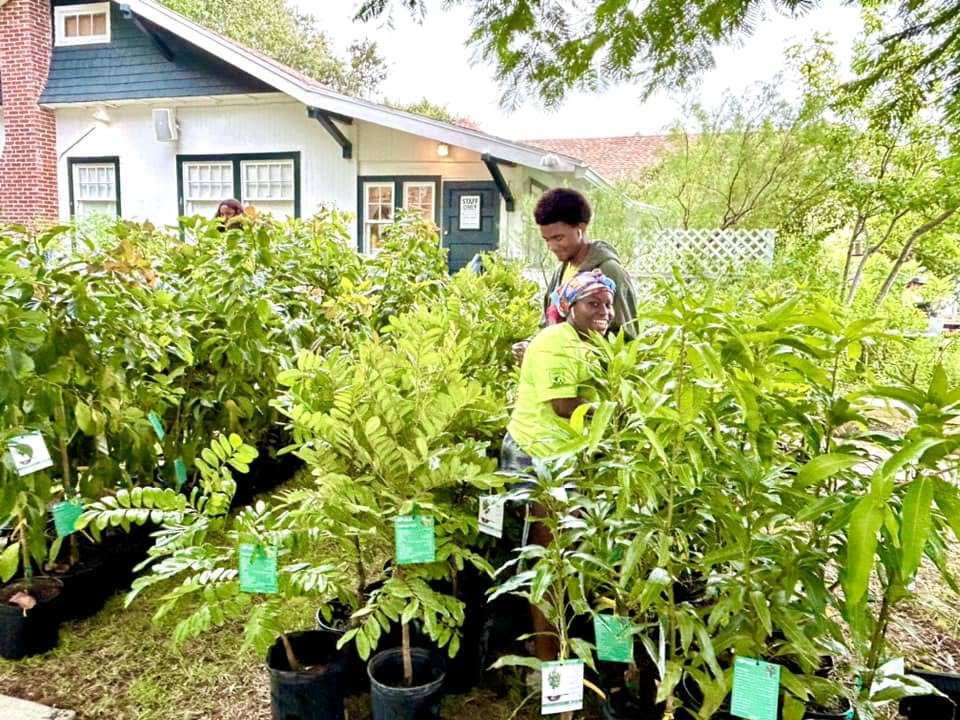
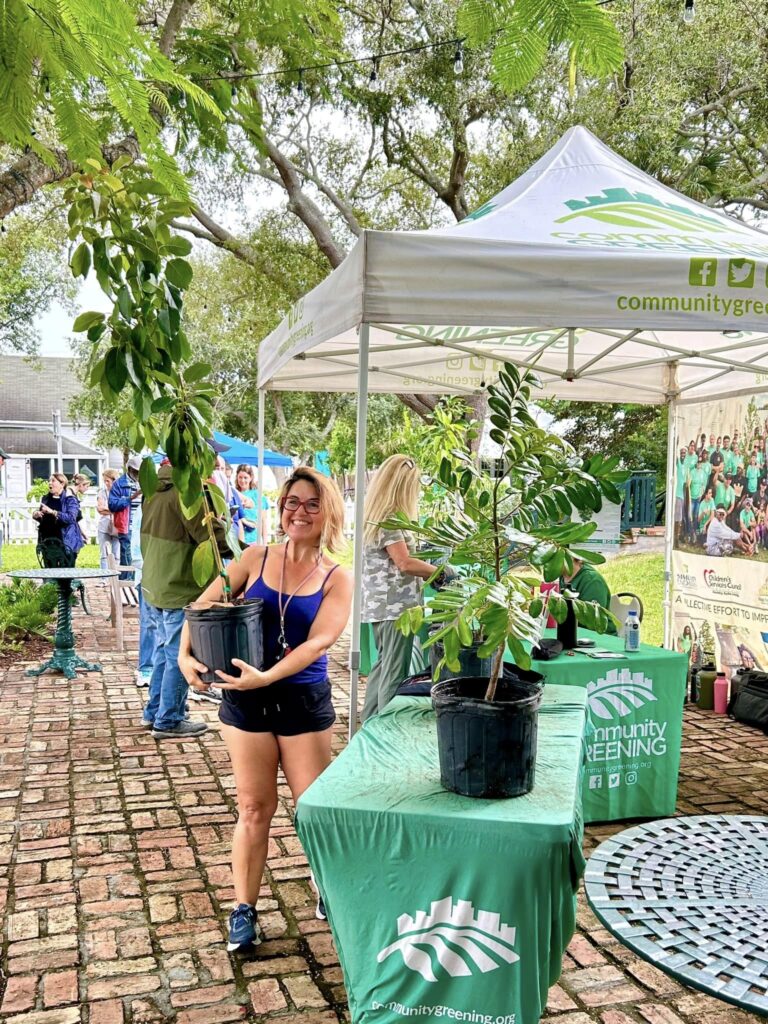
To continue the tree planting program, the City entered into an agreement with Community Greening on June 14, 2022. The agreement was for a one-year tree planting program, with three subsequent yearly options for renewals, to perform the additional plantings necessary to reach the 10,000-tree goal. This effort was to be funded by the Tree Trust Fund.
Making Your Own Legacy with Trees
“Another Day in Paradise” is a phrase often used by people here in Delray Beach. That paradise is only possible with our trees. Taking care of the trees we have, especially the native trees, deserves to be a priority. Let’s do our best to find the best examples and give them extra attention. And…adding more shade is an excellent way to help cool our city in the face of rising temperatures worldwide. Plant a tree whenever you are able. Care for them and help teach future generations how special they are.
For questions or comments, please email the Historian and Archive Coordinator at [email protected].