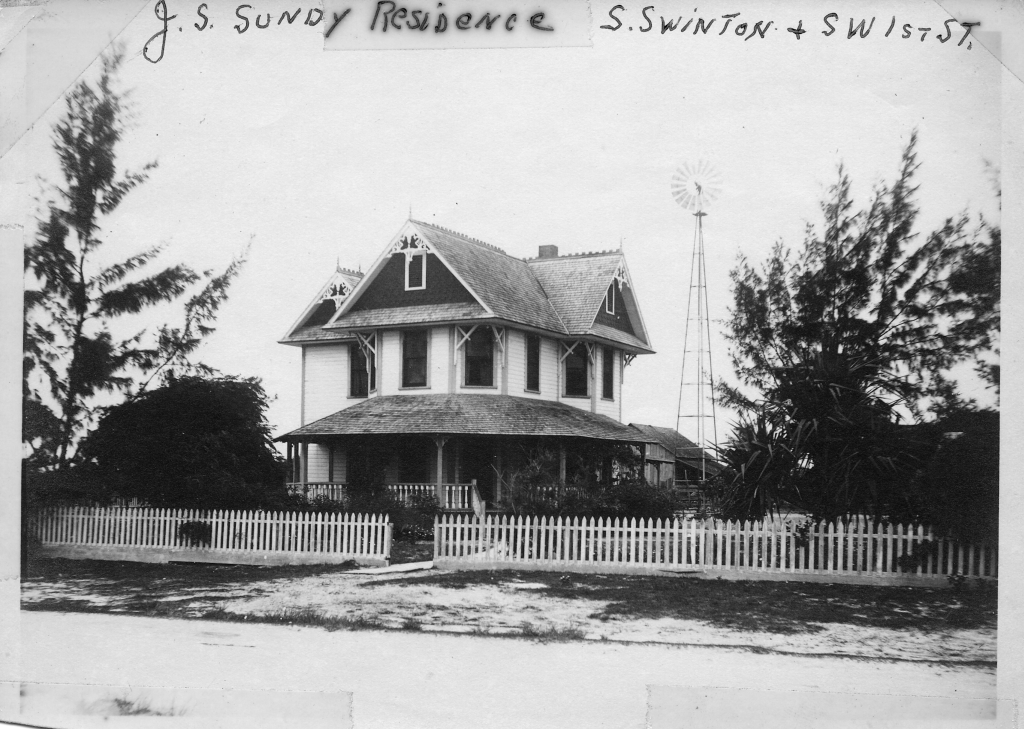
The Sundy family came to Delray from South Carolina in 1898. The family’s patriarch, John Sundy, was a construction superintendent for the Florida East Coast Railway. Henry M. Flagler initially told Sundy “There’s nothing here,” when he arrived in Delray. Sundy replied, “There will be.” His wife, Elizabeth, was a founding member of the Ladies Improvement Association in 1902 and chaired the first board of education. She taught Latin to Delray’s high school students. She also taught English to Seminole women and the Japanese women from the Yamato Colony. John and Elizabeth Sundy had eight children. When Delray was incorporated in 1911, Sundy became the town’s first mayor. He was re-elected eight times, though not consecutively.
Below is a video and edited transcription of an oral history interview completed by Delray Beach Historical Society members JoAnn Peart and Clemmer Mayhew III with Addie, Daisy, Glenn, and Pete Sundy, four of the Sundy children. In this interview, the Sundys talk about coming to Delray, their childhoods, Delray Beach during the 1930s, and more.
Sundy Family (Daisy, Addie, Glenn, and Pete Sundy) Oral History Interview, 1988
Edited Transcription
Some language in this transcript may be offensive. It is presented as it exists in the original audio recording for the benefit of research. This material in no way reflects the views of the Delray Beach Historical Society.
Transcription completed by Kayleigh Howald and Zohar Ouazana.
——
JoAnn Peart (JP): This is June 23, 1988. It’s the Sundy’s residence on 106 South Swinton, Delray. And this is Daisy Sundy, Addie Sundy, Glenn Sundy, and Pete Sundy. And one of you started to tell me there were eight children? And how did it start, in what order did it…
Pete Sundy (PS): Addie was number one, brother Ben who passed on was number two, John who’s in a nursing home in Jacksonville is number three. Sadie is number four, then Glenn. Then Daisy. Daisy, and myself.
JP: And you came on the train in 1898?
Daisy Sundy (DS): Dad, he came with Flagler when it built the railroad. When it got as far as Delray, my father told Mr. Flagler, “I’m stopping here.” He says, “John there’s nothing here.” My Daddy says, well, there will be someday. So, he was the first mayor in Delray.
JP: And was the family with him on the train?
DS: Addie, Ben, and Sadie. And John. Four came and the other four of us, were born in Delray [PS: Four of us.]
Clemmer Mayhew III (CM): What was your mother’s name?
DS: Elizabeth Catherine Shaw. S-H-A-W. Sundy. [CM: And was she from?] Lillington, North Carolina. And my father was in North Carolina too.
JP: Oh. Were they both from Lillington?
DS: No, my father was from Fayetteville. And our mother was from Lillington.
PS: But his family moved to South Carolina when he was about five or six years old. He grew up in South Carolina. Down around [unintelligible].
CM: Where do you think they first heard of Delray?
PS: Well it was Linton then. [CM: It was Linton?] Yeah.
Addie Sundy (AS): [Unintelligible] Michigan, came down with a colony of people and started Delray and called it Linton. And they were, they had never farmed or done any manual labor. And they had quite a time figuring out [PS: The land] the growth, such a heavy growth, the palmettos and everything.
CM: He arrived at the corner of the Intracoastal and Atlantic Avenue. Before the train, didn’t he? Mr. Linton?
DS: Yes.
JP: How did he get here?
CM: By barge.
PS: Did he come by water or by rail?
DS: Mr. Linton? [CM: By water.] He’s talking about Mr. Linton.
PS: Oh, Linton. Oh, that’s right.
JP: What year was that, that Mr. Linton came down?
AS: Linton came by water. Down the canal.
DS: You know what year Mr. Linton came, Addie? [AS: No.] It was around the 1900s.
PS: 1890 or before.
JP: Did you remember Mr. Linton? Know Mr. Linton?
AS: Did I know him? [JP: Yes.] No.
DS: It must’ve been earlier. [PS: She was too young.]
JP: To remember? [PS: Yeah.]
DS: It came in early 1900s and she was born in 1895.
CM: Can you remember Mr. Linton’s house on the southwest corner of Atlantic and Swinton? Do you remember the house that used to be there?
DS: I don’t. Do you, Pete?
PS: Do you, Addie? You remember the Linton house-home? Southwest corner of…
AS: It was torn down. It was on Atlantic Avenue. It was just a little wooden house.
DS: It was a wooden shack.
JP: And then, I guess he moved back to Michigan before you were old enough to remember him. And then his friend, Mr. Swinton. Did you ever meet him or was it… Mr. Swinton? David Swinton?
DS: Have you ever met David Swinton?
AS: No.
CM: They had a bad crop and everything.
DS: Freeze. Big freeze.
CM: Big freeze.
PS: And they stayed a few years. [AS: What?] I think they stayed a few years.
DS: Had a big freeze, they went back to Michigan.
AS: In two or three years.
JP: So then what did your father, was he a farmer then when he first came or did he [PS: Railroad.] work on the railroad?
PS: Railroad. My father worked…
AS: He came on the railroad.
DS: But then he quit the railroad when he got to Delray, then he went into farming.
PS: No. No, no. That was…
AS: No, he stayed with the railroad for a few years.
PS: I remember him saying he worked with the railroad, half a day with his men and half a day on his farm clearing land. How about that, Addie? Is that right? [AS: Yeah.]
JP: When you were first here, there weren’t even any schools, were there? [AS: Weren’t any what?] Or the school wasn’t built or anything. When you were, do you remember when they built the first school?
AS: When they built the first railroad?
DS: No, Addie the first school. When they built the [unintelligible.]
AS: They built the first school when I was five years old. There were six pupils.
JP: They had to have six children to open up the school?
DS: So they had to wait until she was five so they’d have enough children to start a school.
JP: To start the first grade?
AS: It was just only one room wooden school building.
DS: Right up here.
PS: Was that about 1901?
AS: What?
PS: What year was that? When you started school? About 1901?
DS: He’s going to the fire, I guess? [Referring to sirens].
JP: So, in 1901, they started about then, the first little school with six children. And was there a teacher here in town, or did a teacher come to teach you?
AS: Did they what?
JP: Was there someone from the town, was the teacher, or did the teacher come from up north to teach you?
AS: The teacher came from up north, a Miss Williams.
CM: Did you like her, Addie? Do you remember her?
DS: Was that Ethel Williams, Addie?
AS: No, it was another Williams.
DS: Did you like Miss Williams?
AS: much. She was full of pep, and young and…
JP: Was that the same Williams that later became the Williams family, Judge Williams and his family? [Daisy: No, honey.] Different family?
DS: No, honey. That was a different one but they were early settlers too.
Glenn Sundy (GS): Addie’s just making up stuff. [Everyone laughs.] Nobodies gonna… Forget about it.
DS: Do you remember Judge Williams? I was asking Addie if that was Ethel Williams, but it wasn’t. They were old family too, you know. The Sterlings.
JP: No, my parents did but I don’t. There’s so many people I knew as a child that I didn’t remember until I was, you know, then I cared about them and I knew. In fact, I saw someone talking to Buster Musgrave at the post office today and I thought “I know that man!” I remember seeing him as a child but I couldn’t remember his name.
DS: Who, Buster?
JP: No, Buster but it was someone talking to Buster. That I remember when I was a small child.
DS: Buster’s a fine man.
JP: Was Buster in school here with you then, too? Did Buster go to school here? [Pete: No, he…]
DS: No, he came here as a barber.
JP: Oh, when he was older. [Daisy and Pete: Yeah.] Well, how many years until the school started to grow and people started to move in? I mean, what was the population there in those early years? Say when you started school and you were in first grade? What do you think the population was in Delray at the time?
AS: Oh, there weren’t more than a dozen families…
CM: I think it was about a hundred.
DS: Yeah, that’s near enough. [CM: Mhm. Daisy laughs.]
CM: And what did you do, and almost everyone farmed? Almost all the families farmed?
AS: Some of them were railroad, came in with the railroad a little later.
JP: Did you help each other out a lot, or get together for social functions?
PS: Picnics on the beach, Fourth of July at the pavilion there. Have sack races and all like that for the kids. Swimming contest. Things like that. Ocean nights, they were the biggest amusement, of course. It was the one we all went to.
CM: Delray was always called “The Ocean City.”
PS: Right! [DS: Right!]
DS: It’s called the Ocean City Lumber Company, that’s where it got its name.
JP: And then, there weren’t any churches there, at the time in Delray.
AS: The first Baptists came in [on] different weekends to preach in the little one room school building, and every denomination went to that.
DS: The First Baptist Church was organized right here in our living room. My mother organized that in 1911.
PS: 12.
AS: 1912.
DS: I stand corrected! [All laugh.]
JP: And how many members were, how many members started the first Baptist church?
AS: Twelve.
JP: Twelve people. And then the Lutheran church, I think, came along.
DS: And that’s the Thieme family you said you interviewed..
PS: The Thiemes, they’re right next door to the church.
JP: I think his father was the minister for a few years, too.
JP: Was he strict?
AS: Yes. [DS: Laughs.]
JP: That’s what Martin said. We asked him what he ever did, what was the worst thing he ever did and he said he didn’t do very much, because his father was so strict.
DS: Sure was. [DS and JP laugh.] I was same age as one of the sisters and I was scared to death to go to her house to play because I didn’t want to get in big trouble. Well not really, but he was very strict. He was old school.
PS: Our mother was real strict on us too. [JP: She was?] We lived over on the beach in the summertime, where Boston’s is now and we couldn’t swim on the Sunday. We’d have to sit out on the front porch like the others. Back in those days, you could look right down to the beach, it wasn’t all filled up. [Unintelligible]… seagrapes.
JP: So Sunday must’ve been a long day for you?
DS: That’s right.
CM: What were the things your mother liked to do? Did she enjoy swimming, or fishing or music? Was there something your mother enjoyed doing?
DS: She enjoyed teaching most of all. She had eight children to help with school. [Laughs.]
PS: She was a great tutor.
AS: She was a born teacher. [JP: She was?]
DS: She taught Latin and History at the school. She taught four years of Latin in school. We didn’t like it when we took it.
PS: That and Mr. Virgil.
JP: So, your father was he the soft touch? The one you’d go to if you wanted something? Or was he strict too?
DS: He was strict too. [Both laugh.]
CM: How did your father happen to become mayor?
PS: I guess he was always politically, political minded. Uh, I know later he used [Glenn: inaudible.]
JP: Oh, I thought I [saw] one of them…!
DS: Yeah, your picture at city hall the other day, Glenn.
JP: And what did Ben Sundy do? I remember he…
PS: He was county commissioner for sixteen years, or something like that.
JP: Oh, so you have a political family.
PS: I was on the schoolboard in North Carolina for twenty-five years. [JP: Oh!]
CM: Did you children go to the ceremonies at city hall? Were a lot of ceremonies in Delray? Because your father was mayor? Did you attend those, or do you remember…?
PS: I don’t, I don’t think there was. Addie, was…?
AS: Was there what?
JP: Was there a ceremony when your father became mayor at the city hall…?
CM: At the train station?
JP: Or at the train station?
AS: Not much, there was just made him go to city hall to swore him in, was all.
JP: What was the little city hall, then? Was it just another little building someplace, or…?
AS: It’s still on Atlantic Avenue, I guess.
CM: Living two blocks from the school, were any of you children ever late for school?
DS: No, we’d sit here… [PS: No, we sit here.] We would sit here and hear the school bell ring and then we’d run. [Both laugh.] I mean in those days, the mayor held court every Monday morning and [unintelligible].
JP: Did you have many crimes or problems then?
DS: Not to speak of, and they always say, that everyone in business, closed, didn’t open their business on Monday morning after my father held court, because he was so humorous when he was holding court everybody just wanted to go and hear what he had to say. For instance, this time we had two [unintelligible] having booze. And the first one came up and said, “where do you get your booze.” He said “I got it in Delray. He said, “That’ll be five dollars in tolls.” Next one came, I said “Where do you get your booze, Bill?” He said, “I got it from Lake Worth, sir.” He said, “That’ll be twenty-five dollars. The cost of not buying Delray [DS and AS laugh.] where would we get a cut from it.” The city would get a cut from. Just funny things. And everybody wanted to go to court and hear what he had to say.
JP: Do you think of any of the other stories? I love those old stories.
DS: Oh I should have.
CM: How did it feel to be living in between two churches? You had the Episcopalians here and then you had the… [Pete: Methodists.] Methodists on the other side of you, and the, it uh, must’ve made you all feel much closer.
DS: It was a lot…
PS: That’s what we did, back in those days.
DS: It was just like one big, happy family in those days.
GS: Cathcart stands right where it is now. [PS: Yeah.]
CM: Do you remember the Cathcart family?
DS: Oh, yes! Just Mr. and Mrs. Cathcart. There were no children.
CM: Do you remember when they were building their house?
AS: Yes, the same people that built this house. The same men built their house.
CM: Do you remember who the carpenter was? [AS: What?] Do you remember who the carpenter was?
AS: Leatherman.
CM: Mister…
DS: Leather. Leather, L-E-A-T-H-E-R, [CM: Leatherman.] Leatherman.
AS: He was him and his son Justin built it. Most of it.
DS: He built this house first and then the Cathcart house.
JP: Oh, they built this house first?
CM: Where did you live when this house was being built? Do you remember?
AS: In a section house, over in…
PS: On the railroad. In the section house.
CM: You lived at the section house on the railroad? Mr. Grant, built the house, didn’t he?
DS: This house? [CM: Yes.] Mr. Leatherman. [Inaudible.]
PS: It was Grant, how did Grant…?
AS: It was Grant who came down from Miami every, [CM: Mr. Grant did?] every, Monday morning and went home Saturday. But Leatherman helped build it.
PS: What about Grant?
CM: Where did your mother and father get the idea to build this house? The design of this house? Was it from North Carolina?
DS: I think so, it was sort of Vic, Victorian architecture, you know. That’s more like, they had up in the Carolinas.
AS: They studied plats, sketches, and…
DS: I remember my mother told me how much it was to build house. Seven bedrooms, four baths, and everything that goes with it and she said $5,000. I said, “Mother you couldn’t build a bathroom for that!” She said, “I know, doll, but in 1902 that was a lot of money.” And they had to bring all the lumber by boat from Georgia to build it.
JP: Because they wouldn’t have the equipment to saw it here.
DS: Well they had no way to bring the lumber except by boat.
PS: How ‘bout the railroad?
DS: Mother says they brought all the lumber by boat from Georgia.
PS: She’s right, I don’t know. [Laughs.]
JP: What is, what kind of wood is it?
DS: Florida Pine.
PS: Georgia Pine!
JP: Georgia Pine?
GS: One of them’s saying Georgia Pine, the other ones saying Florida Pine. Neither one of them is probably true! [Laughs]
AS: It was real small then. The government has enlarged it three times.
JP: The canal was so small then, it’s been enlarged three times by the government?
CM: With eight children in the house, there must have been a birthday party going on?
DS: Continual.
CM: Continual! [CM and DS laugh.] Were there lots of celebrations in the house, for Easter, for Halloween [DS: Right. That’s right] and birthday parties?
PS: There was a party about every day at that big dining room table. All ten of us around it. I can sit here and describe it.
CM: Do you remember the first Christmas in the house? Addie, you remember Christmas? [DS: Christmas in this house?] Which Christmas as a child can you remember?
AS: We always… Mama and Pop would make a lot on special days, and on Christmas Eve, they put all the straight chairs in a circle, like, in a semi-circle. And then they, and all we children and some would put our stockings on those chairs and it was a lot of fun.
JP: You hung your stockings on the chairs?
PS: Uh huh, and the presents we’d put in the den. Santa Claus would lay the things in the chairs. [Laughs.]
AS: Most of them had little knobs.
JP: Oh, that’s a cute idea!
CM: Were there eight bicycles around the house? [DS: Laughs.] I sense a lot of…!
AS: There wasn’t much… toys. Maybe a ball or a bat for the boys and a doll.
GS: All of that’s not true but nobody’s gonna doubt it. [Laughs.]
DS: Maybe a baby doll for the girls.
JP: And now there’s so many more toys now than there were when I was a child but I could imagine… [Pauses as truck passes.] Well, what about, um, food shopping? When you first came, there were no grocery stores or anything, were there? Was there…
AS: Well dad went to Palm Beach once in a while and then they had things brought down from Jacksonville.
CM: Did he go on the train?
DS: Did Dad go on the train?
CM: Or did he drive up the Old Dixie?
PS: That was, later years when he would drive up. When was the first car, Addie?
AS: I remember [PS: Huh?] the first car, it was an E.M.F. but I don’t…
PS: About 19-before I was born. 1911? Uh…
DS: We owned the second car in Delray. Dr. Cason, the only doctor, had the first car. He got the first one because he was the only doctor. [GS: Or E.M.S… inaudible.] He was the only doctor between Lake Worth and Fort Lauderdale.
PS: And you were the first driver!
JP: And he would make house calls? [DS: Oh, yes!] Any time of the day or night?
DS: Anytime if any of us children were sick, he’d come stay the night here. Boy! Can you imagine?
JP: No! A doctor that spends the night, that’s… That’s incredible. And he delivered all the babies in their homes?
AS: Yeah.
DS: There weren’t any hospitals.
AS: There was a midwife that was real good that… Delivered some, too.
DS: [To group of people off screen walking onto the porch.] Where was the fire?
Unknown 1: Oh, another one.
Unknown 2: There wasn’t a fire.
DS: Well, what was all that to-do about? [Laughs.]
Unknown 3: False alarm. [DS: Oh dear.]
PS: We always, I had a lot of Blacks working, when father, working for, around, on the farm and around here. Working around. Everyone came right here to work in the morning, all the help. He’d meet them out in the back.
CM: The Black community in Delray is the oldest in Palm Beach County. [DS: That’s right.] Do you remember… Was there much going on between the Black community and the farm community? Was it… They have their neighborhood [DS: That’s right,] and this neighborhood was here [DS: That’s right.] and the beach area had their neighborhood?
GS: I wonder where I was when all that was going on.
PS: I thought you would come up with something! [Laughs. GS: You make it up, buddy!]
DS: That’s right. We have a house in the backyard back then where two of the yardmen lived, so we had two on the grounds day and night.
JP: And did they help with… Was… did anyone help with the household? Like washing the clothes? [DS: Sure.] A colored, a Black woman, or…?
DS: Oh yeah, singing out there.
PS: Old wash pot, old wash pot’s back there right now, where we used to put all the clothes in. I got flowers planted in there.
JP: Oh, we should get that on the video! That would be cute. What else did she do?
DS: Just did the housework, washed the do.
JP: Did she cook, too?
DS: Sure. Always had a cook.
PS: Mother supervised. [Chuckles.]
CM: What, what kind of, uh, food were you, uh, eating? Were you eating deer, and boar and, or… Do you remember any…
DS: Mostly chicken.
CM: Lots of chicken?
DS: Lots of chicken.
CM: Did you have lots of chickens running around?
DS: We had a big chicken yard back there, too.
CM: You had a chicken house here?
DS: Yeah, we always had cows back there.
CM: Oh, there were cows here! [DS: Oh, sure.]
JP: So you had your own milk, right.
DS: Right here on the ground.
PS: Had a couple of cows.
CM: Couple of cows here.
AS: And then Dad raised a few pigs. We used to have an old sow and pigs and…
CM: Right here in downtown? Pigs and cows and…
DS: The property goes all the way through block and around the back we had all the chickens and cows. [PS: Mules and horses.] That’s what we called the Men’s House where the two colored men always used to be.
CM: That might be an idea for city hall today. Put some cows.
GS: We never had any sanitation then. [GS and PS laugh.]
JP: Oh you, had an outhouse then, you mean?
GS: Yeah.
PS: [Laughs.] I tell them.
GS: That was all over the backyard. [PS and DS laugh, PS taps him.]
CM: Plumbing was introduced…
PS: We had one bathroom and it had a water tank in the windmill back there, you know. Gives the house all its running water back when it was built.
JP: One bathroom for…
PS: Ten of us!
JP: Ten people! Great line once in a while? Did you have to wait in line once in a while?
CM: Do you remember the Seminoles?
PS: No, we didn’t…
GS: I don’t remember.
PS: We got a lot of [inaudible] here.
DS: I’m sure Addie remembers.
CM: Addie, do you remember the Seminole Indians? When they came into town, over to the feed store?
AS: Oh yes.
CM: Did you like the Seminoles?
AS: One morning, the Indian squaws they bought salt from the… to cure the Alligators hides with and I, I got to be quite friendly with the women and I’ll never forget, I reached up and asked her if I could feel her hair. She wore a ring around it and wrapped her hair. And she said, “Take it off,” and she took it off and showed me, kind of a brass ring. And then she wrapped her hair and then it was quite unique.
DS: Always wore that Seminole dresses that… [PS: All colors.]
AS: And they were all so friendly. You just love to have them come in.
CM: Do you remember the Japanese at Yamato and Mr. Morikami? Did they come into the store, also?
DS: Oh, we all knew them.
AS: They were good customers.
DS: All the Japanese children came up to the Delray school. They were real good students.
JP: They were?
DS: Oh, very good students.
PS: They were always bringing something and leaving it on the front steps here.
DS: My mother taught them English.
PS: For festivals or something.
JP: Oh, isn’t that nice.
DS: The, uh, men went back to Japan and brought their wives back and they couldn’t speak English, so my mother taught the wives how to speak English and she wouldn’t take any pay for it so every Christmas, they’d come with all these gifts for her [JP: Aww.] Cause she wouldn’t take any pay for teaching them English.
JP: Would they come sit in your living room to learn with or… the porch?
DS: No, they used to come and sit on the porch. [JP: Oh!] I was in school, there was a girl named Chicaca…Chicaca Sakai which is Catherine in English. She was an A student.
PS: Roku was one of my friends. [Laughs]. Roku Kamiya.
GS: What was it?
PS: Roku! Remember Roku?
DS: George Morikami was a wonderful citizen.
GS: No, we never had one with that name.
PS: That’s that Japanese.
GS: Go ahead, make up stuff, they won’t know the difference. [PS laughs, points at him, then DS laughs.]
JP: [Laughs.] He’s accusing his brother of making everything up.
DS: Yeah, I noticed!
GS: Well, a lot of things he’s talking about never happened! [Everyone laughs]
PS: Oh! You forgot, Glenn. [Everyone laughs.]
GS: Go ahead, I won’t stop you anymore.
JP: When you… The Black lady cooked, what kind, what did she cook? What kind of meals did you have?
GS: Tell her, Pete!
DS: Corn bread, and biscuits but bread. They’d make wonderful cakes and pies.
JP: And black eye, did you have black-eyed peas?
DS: Oh, you better believe it! Yeah, good ol’ soul food as we called it.
CM: Was there something in particular your mother liked to cook? [AS: They used to bring us huckleberries. By the water bucket full.]
DS: No, she was a good cook, but she always had a cook. But she’d always be in the kitchen sort of overseeing it.
JP: So, she made pies with the huckleberries?
AS: Yes, Mama would can a lot of them when they were ripe and then during the wintertime, Mama would make huckleberry pies. A deep-dish cobbler, as you’d call it, things like that.
DS: And guavas too. Guava jelly. You hardly ever hear of that.
JP: Oh, I love guava jelly.
DS: Oh me too, but… Excuse me. Almost all the guava trees are extinct. Yeah, every one.
JP: I had a horse, and we used to ride along the canals and every once in a while, his head would go over and he’d grab a guava and eat it.
DS: The horse?
JP: The horse did! He loved guavas. And I wouldn’t even see the guava tree but then he would see it. Or bush.
CM: Do you remember back before World War I and during the 1920s, did you used to measure time by our seasonal visitors or by what crop was plentiful that time of year, or did you measure time by the school year and, summer was a time… Do you remember how you used to at each year? Was it when you were working at the store? Was it the crops that Delray, the gladiola, the flower farms or, do you remember…
AS: How you measured time?
CM: Yes! How did you, what time would you wake up in the morning and go to bed at night, and how…
AS: We generally went to school at 8:30.
CM: In the morning?
AS: In the morning, and got out at three, as a rule.
CM: Did you have chores to do before 8:30 in the morning, so you were up at dawn? Or were you…
PS: The boys had to milk the cows and put them out in the pasture.
CM: So you were up at around six every day. [PS and then AS: Yeah.] Then did you come home and do homework or did you go and work at the feed store or did you… [GS: Tell them something for me; I don’t…]
AS: Well, the feed store, was started in 1914 [GS: Make up something. PS laughs.]
CM: So, you were out of school by then.
AS: I had to start work then, so I spent all my time at the feed store.
CM: What time was dinner each day? Did you… Do you remember as a child what time you…
PS: Twelve o’ clock!
DS: Twelve o’ clock!
CM: That was dinner, and then supper was at what time?
PS: Six. [CM: Six.] Right, Addie?
AS: Around dark.
CM: Then what happened after supper? Each day?
DS: That. [Chuckles.] We all sat around the dining room table and did our homework. And our mother would go from one to the other and help them with homework.
CM: How wonderful! [Laughs.] Did the family have a radio?
AS: No radio.
CM: There were no radios in the house.
AS: First thing we had was a graphophone.
CM: Really? Do you remember any music that you used to hear on the gramophone? Was there, a group or someone you liked to listen to? Do you remember listening to…?
AS: Well you got records… [CM: Yeah?] You bought records and you heard those records play.
CM: Did the kids ever fight over the gramophone, or…? [AS: No.] Did you like the gramophone, Addie?
AS: Pretty well.
CM: Did you sing as a child?
AS: No, I wasn’t a bit musical.
CM: Did Sadie sing?
AS: No.
CM: Did any of the children?
PS: We had a piano, and they tried to get…
CM: You had a piano in the house? [DS: Everybody had to get piano lessons.]
PS: Yeah. They tried to get everybody to take music classes but they wouldn’t take [Laughs.]
AS: Our sister that we lost could play the piano a bit, she was the only musical one of us, and she played the piano. Had a right nice voice.
GS: Who was that? [Inaudible, DS and PS laugh.]
CM: Would you go to the old school for recitals? Were there events up at the old school that you used to go to?
DS: Sure. Had hometown plays, you know?
PS: There, there… Lance stayed… [Inaudible.]
JP: Oh, he did?
PS: Uh huh [affirmative], he’s been out there a couple years, I went after him a while ago.
JP: Oh, good! I’m glad.
CM: Did you used to travel any in the summer when school was out, did the family go to North Carolina in the summer? Or did you stay here year-round?
DS: Usually went to up the mountains in North Carolina.
CM: You did go to North Carolina.
DS: And when we didn’t go there, we owned a home over on the beach. We’d go over there and spend the summers.
CM: Where was the Sundy house over on the beach?
DS: Wait, you know where Boston’s is now?
CM: Yes.
DS: We owned all that property all the way to that block we had home.
CM: The old Sarah Gleeson block.
DS: Yes. And…
PS: They had two big homes over there. I believe we lived in one and rented the other.
CM: So, this was a city and then you had a house over on the beach as a beach house.
DS: And let me tell you something interesting; in those days, we didn’t even have a key to the house [gestures to home behind her]. We just closed the windows and shut the doors and then so and stay all summer long. Never locked the door. Can you conceive of that that today?
JP: No. Even in the ‘50s, I remember, we didn’t lock our house over on 7th Avenue.
DS: I bet you didn’t!
JP: But it sure has changed.
DS: Oh, honey.
JP: How do you feel about all the changes?
DS: Oh, I hate it. [Laughs.] I liked it like it used to be.
PS: [Inaudible.]
JP: That’s, somebody, anyone else would say it’s built up here like it was in the ‘50s.
CM: Did you used to go to the movies very much as children?
DS: Yeah. Cost us ten cents.
CM: Cost ten cents?
PS: Was it that high?!
DS: Yeah! We took ten cents.
CM: Would you go on Saturday mornings?
DS: Saturday afternoon, usually. They had a little matinee.
PS: That was right up the street, I guess you have a picture of that.
DS: Yeah, I know there’s a big drive-in.
JP: The old Delray Theater, by the highway? [DS: Yes. PS: No.]
DS: No, honey, over here on Atlantic Avenue.
JP: Oh! There was one before that one? [PS: Yeah!] Ohh!
PS: I’ve seen a picture of it around here, somewhere. Oh, there’s one in city hall.
JP: Oh!
AS: One interesting thing used to come in here, in the winter. I guess, a colored men’s group, they came in one of the train cars, when the railroad was built, and they stayed one night, and put on a show. Everybody went, a lot of people went to the show.
DS: Silas Green from New Orleans! Remember? [Laughs.]
PS: The house caught on fire one… The house caught on fire here, one time. When the Georgia parade, Silas Green, and all those, and the parade, and the Blacks came over and helped move furniture out of the house.
JP: Oh your house caught on fire?
PS: Yeah, it did. I think it was the fireplace or something was it what caused it.
DS: And I remember the telephone was right on top of the door over there and I had to crawl up on a chair, call the fire department. And then about five minutes later, a lady called back, and she said, “Daisy, is the house really on fire or are you teasing me?” I said “No, I’m not teasing, our house is on fire!” so she says, “I’ll call the fire department then.” [Laughs.] Because of the weather, we’d have a fire the fireplace and the sparks they caught the roof on fire, and they got the fire out. There was men who came in, carried it out off the street. All the heavy furniture and helped get it before the whole house burned up.
GS: That’s before your time! [Pete laughs.]
CM: Do you remember Delray during the war? The first World War and the Second World War. Was there…
AS: We had to keep blacked out at night and keep dark curtains over our windows. That was World War II.
CM: Did you have to drive around without the lights on?
AS: We didn’t drive around much. At night.
JP: You stayed home?
AS: In World War II, there were five ships, sunk right out here by the shore.
DS: Here in the summer.
CM: Did you go over and see the battleships as they were passing by from, uh…?
AS: Oh, yes. And then they had the… What did they call it… Commercial ships would go in a group. And then an airplane, and the submarine flying around, and we’d watch them go by.
PS: You were born after that.
JP: In 1950.
PS: Well, you best start with that!
GS: What about the hurricane of 1928?
DS: Oh!
CM: Do you remember that?
AS: I certainly do!
PS: Very, very well.
DS: We all do.
CM: Do you remember the feeling before the hurricane? Did you know the hurricane was coming?
DS: No! We had no way in those days. They didn’t warn us.
AS: On Sunday, they came over, Western Union, and reach us with a tele, with a telegraph operator, and we’d gone to church and Papa was home. [GS: Whose she talking about? PS: Hurricane. GS: Who?] He called on and told us, that there was a storm predicted and would hit us, late that afternoon. But we had, um, we were, got us a good many years, several years, lived in our house, it was, you know, it was in 28.
CM: As the winds grew to a 160 miles an hour, were all of you children down in the basement?
DS: We didn’t have a basement! [Laughs.]
CM: Or were you…?
PS: See those Australian Pines, right over there? They were all around this house, and they blew in every direction, they just…
CM: Was the house tied down, or…?
DS: No!
PS: It withstood the storm.
CM: Addie, do you remember the feeling of the storm, that night?
AS: Oh yes, it, it, the house shook.
CM: You could the house shaking?
AS: Oh yes. Eh, one of those pines fell, across the upstairs bedroom window, and the dining room, and broke off some windows. So, when it let up, there was a little house next door, with some neighbors in it, and we took a lantern and went over there. And with those hurricanes, they come from one direction, and blow out, and then they, they, get a lull…
PS: We were right in the middle of it.
AS: … It comes in another direction and then comes back.
CM: Did the house over on the ocean survive the storm?
AS: Yes. Yes, it was damaged some, but not too badly.
GS: It was a real thing.
PS: The insurance gotten us paid off mighty good! I remember that. It even gave dad a new set of golf clubs! [Laughs.]
CM: Some things have changed! [Laughs.]
JP: When you, when you took the lantern and went over to the neighbors, were they okay?
AS: Yeah. [PS: Yeah.]
DS: What I remember most about that storm was, the Methodist Church was up on this next corner and the Episcopal Church was down here, and the early part of the storm came from the south. And uh, we looked down and here came the Episcopal Church, flying down, swimming down here…
CM: Oh, the Episcopal Church was, actually [DS: Down…] moving down the street?
DS: Oh, yeah! And then after the lull, [GS: I like that, that’s a good…. PS: Laughs.] the storm came back from the north, we looked up, here came the Church, flying down. [CM: Laughs.] So, they all passed by! [Laughs.]
CM: The only thing was missing was the flying nun!
DS: That’s right! [Laughs.]
JP: Addie said they were small wooden buildings at the time.
CM: Yes.
DS: That’s right.
JP: Oh, that’s…
PS: Course that was the other way.
GS: The Methodist, had to go down the street, they didn’t go on the sidewalk.
CM: What was the spirit of the community after the storm? Was there an immediate sense to start the rebuilding?
PS: My mother said, I remember her saying that “I never wanted to go back, on that, I’m ready to go back to North Carolina.” But when it got to the day she was over there, she said “Well, I’m over that, I wanna stay here.” She said that.
GS: Why’d she want to go back [to North Carolina]?
DS: She wanted to get out of the hurricane!
PS: She wanted to get out of the, the storm.
CM: Do you remember life in Delray during the Depression? How was that? Was the community deeply affected when the banks…
PS: We thought we were getting along good!
CM: Do you remember the day when the banks went under? Addie, do you remember?
DS: Yeah, ‘cause our oldest brother was the president of one.
CM: Oh! [Both laugh.]
PS: Had a meeting here. He had a meeting in this house the night before the bank closed, here!
CM: It’s good sixty years later, we can smile about it.
DS: Yeah, that’s right.
CM: Well, the depression must’ve been a difficult time. Like a lot of building over on the beach.
AS: Well, we hadn’t been used to so much before then.
GS: When was the depression?
DS: Twenty…
PS: The thirties. [Laughs. GS: Huh?]
DS: Twenty, twenty-five, twenty-six, I mean, twenty-six, twenty-seven.
PS: That was when the bubble burst.
CM: Addie, do you remember a newspaper called the “Wonderland Developer?” From the 1920s?
AS: No, I don’t.
CM: Or something called the “Delray Rays?”
AS: See, I remember the Delray Rays. [Rays of Delray newspaper]
CM: You do remember reading that?
AS: Yeah.
CM: We’ve never been able to find a copy of it.
AS: What?
CM: We’ve never been able [GS says something to PS] to find a copy of it.
GS: That was before my time.
CM: Do you remember when women were allowed to vote in Delray? Did they…
AS: I don’t remember the date but I remember when they were. I voted the first time.
CM: Was there a great deal of celebration?
DS: Do you remember when you voted the first time?
AS: It was, just as soon as I could vote. Dad was so politically minded that he thought we all ought to take advantage of it.
CM: Was he in favor of women voting?
AS: Oh yeah.
CM: I’ve read several places that Delray was the first town in the state of Florida that allowed women to vote. [AS: Oh!]
DS: Is that so?
CM: It was a very progressive town.
GS: I never heard of that.
CM: Well, I read it several…
PS: Well you made a million before you were twenty-five and broke by the time you were thirty! [CM: Laughs.] Is that right? [Inaudible.]
DS: Yeah, everyone was rich just before the boom burst and then everyone was poor to go to thirty.
CM: Did you ever go out to Lake Ida as children and picnic out by the pineapple farms?
DS: Lake Ida had oyster roasts. They had oysters out there then.
CM: Oysters?
PS: No! Not, not Lake Ida, Lake Worth, or uh, whatever it was called.
JP: Lake Worth.
DS: Lake Worth.
CM: Lake Worth. Well, they’re both lakes. [CS and PS: Yeah.] Did you ever go out to Lake Ida as children? [All: Yeah.]
JP: Well, it was a man-made lake, though, Lake Ida. So, it wasn’t much of a lake there for a long time. Is that right?
PS: Oh, yeah. There was nothing there. It used to come up to Swinton Avenue there.
DS: Up on North Swinton that was all water.
PS: The lake had way up… [Inaudible.]
JP: Oh, I thought they dredged it all out! I thought it was.
PS: Well, it was larger, and they dredged it and drained it. That’s what…
JP: Oh, and made it deeper. [DS: You’re not very (inaudible), are you?] So, it, oh…
AS: We had a drainage district and two big dredges, drained all around back there.
PS: My father used to farm close end of town, but they kept draining and he had to keep moving out, where to… Um, little more moisture to it.
JP: What, what’s built where his farm was now? Do you know what’s there now?
PS: Out here, the Germantown road. Where the Germantown road makes a left, that street goes on. That was all, that was all his farm. Back then, that way.
DS: What we call that? You remember?
PS: What?
DS: What we call that? We had a name for that farm.
PS: I don’t remember that, that’s where we used to have a lot of hogs out there…
CM: Do you remember Mr. Pruger’s farm? Gladiolas?
DS: I’m sure you did. Do you remember Mr. Pruger’s gladiola farm?
AS: Oh yeah.
PS: That was the gladiola man.
AS: Yeah, I remember. We had some pine trees I ordered he gave us.
CM: Mr. Pruger.
JP: Did, did you get any mango trees from the Zills?
DS: Yeah, Lawrence Zills spent the afternoon with us the other day.
JP: Oh, he did?
DS: Oh yeah, he’s an old-time friend of ours.
PS: Lawrence and I left here during the Depression, hitchhiking. We went all out west. Lawrence came back, I tell people “Lawrence came back, he got rich and I stayed in North Carolina poor.” [CM and JP laugh.]
DS: They came back, spent a weekend with Zill and me up in North Carolina and Pete, decided to stay a little longer, so he’s been there fifty years.
JP: Oh! [Laughs.]
DS: He came to stay a weekend; he stayed fifty years.
PS: I stayed, and they came to Florida!
JP: Well, Mr. Zill made most of his money in land, didn’t he?
PS: That’s right.
DS: You know he owned all that land off the highway where go and made the shopping center out there. He got his crew…
JP: I used to love to go back there and taste the different mangoes that he had.
DS: Yeah, you like them?
JP: Oh, I love mangoes.
CM: As children, did you enjoy being the center of the political life of the town? That variably everyone came through your living room? Addie, did you sort of enjoy that your father was mayor, and everything? Did you kids feel like you were more part of the community because of everything that went on at the house?
AS: Yeah, you felt part of it. And Mama and Papa were both so interesting, they politicked. Mama was on the schoolboard and did a lot of work there.
GS: What year was Mama on the schoolboard?
PS: That was before my time. I didn’t come along then. Not until later!
DS: I was walking down the street one day and I passed my father and I said “Hi Mr. Sundy!” “Hi there! How are you?” He didn’t even recognize me! [CM: Laughs.]
PS: He was hard-hearted.
CM: I’m sure at election time, he recognized you.
DS: Oh, you better believe it!
PS: He figured, about his work, he knew what he was doing. So…
CM: Do you remember going out into the Everglades as children? Did you ever go hunting out beyond the flatwoods?
DS: He did, the boys.
AS: We used to go out back then. We’ll spend a day on one of those…
DS: Swamp buggies.
AS: … Funny boats.
DS: The swamp buggy, Ad?
AS: Yeah. Go all around out there.
CM: What did you see out in the Everglades…?
AS: Catch fish and fry them.
CM: …Sixty-five years ago?
GS: What were the swamp buggies?
DS: What Addie, fishing what?
AS: And fry them.
PS: They had an airplane engine on them.
DS: Oh, and lots of fishing.
CM: Were there deer out there? Would you see deer and Indians, or…?
AS: No.
DS: I thought there were Indians out there?
CM: Were there any, Florida wildcats out in the Everglades, or…
AS: Oh yes. [CM: There were?] There was wildcats.
PS: Lot of those between the Intracoastal and the beach, out. [CM: Oh, really?] That, that was swampy country over there.
JP: And bears? Were there bears?
AS: No bears.
DS: No bears. [Laughs.]
GS: Elephants. [PS laughs, lightly slaps GS’s arm.]
JP: Did Lora Britt Sinks… It said they, uh, they, would get the turtle eggs quickly off the beach before the bears came? I thought it said that.
DS: I don’t remember that. We used to go very late but I never saw any bears. [PS says something about the Everglades.]
JP: What did you used to do with the turtle eggs?
GS: We had turtle egg fights on the beach. [JP laughs, PS slaps him again, laughing.]
DS: I remember we brought a whole boatload home and there, out there, in the yard and in due time, they hatched and had all these little turtles. Then we took them to the beach and them in the ocean.
JP: Oh!
DS: They were the cutest little things you ever saw.
JP: Oh, they are cute.
DS: Yeah. Of course, that’s against the law.
JP: Well now, yeah. Did you ever…
DS: The colored people ate them. They loved it.
JP: Did they taste like…
AS: Colored people are very fond of turtle meat.
DS: I don’t know, I ate them.
AS: But the whites didn’t, you couldn’t congeal, the yellows were all runny.
GS: What’d you do with the pipes?
AS: Throw them away.
GS: Oh.
PS: That was before your time. [Laughs.]
CM: Do you remember, when in 1925, they were building the high school and the? Do you remember, Addie?
AS: The what?
CM: When they were building the high school and the gymnasium?
AS: Oh yeah.
CM: Did you remember the architect, Sam Ogren? Or the builder, I.J. Sinks? Did you know, uh…
AS: I knew both of them.
DS: 1926 was the last year they had the school open right up here. And the next year, they opened one on Swinton.
CM: Do you remember Willard Waters, the builder?
DS: Oh yes! [PS: Yes.] He was one of our close friends! [CM: Oh, really?] Oh yeah. He’s a real…
PS: Glenn…
AS: He had a sister, Edna and Miss Waters was… Quite active.
CM: Edna’s still alive! [AS: Oh yeah.] She’s eighty, I think eighty-eight and living in a small Georgia town.
DS: That’s right. They bought an old home up in [Inaudible.]
CM: Yes, I found her about two or three months ago [DS: Oh, did you?] and she has sent us some early pictures of, uh, life in Delray, and it was sort of wonderful talking to Willard Waters’ sister [DS: Yeah.] Edna. But she’s fine! She can’t travel much or not at all. But, uh, it was sort of wonderful finding her.
PS: You know what town she lives in?
CM: I have it at the office. And I received a letter from her, and she was so surprised to hear from anyone in Delray Beach. But she sent us the most magical pictures of early Delray, over on the ocean where the Waters had a house, where the hotel is now, just north of the hotel. [PS: Yeah.] And they owned all the way down to the Intracoastal. They had a, was it a farm also? Were they… ‘Cause everyone farmed.
JP: Which hotel, Clemmer?
CM: Just north of the, uh, Seacrest Camino hotel. The Waters may have the original quotas and…
JP: I thought the Hardwells was on that land? Between the Intercoastal and the ocean?
CM: Well, the property went through many hands, uh, after the sales, and then before the twenties, uh, and the, after the Depression, uh, lots of properties went through many, which, which caused the collapse of the system. You know, it was that, I guess you were involved with it, here at the house where everybody’s property was worth a million one day and then the next day it wasn’t, it wasn’t worth anything. [DS: That’s right.] And uh, then Florida during the boom, was like living in a roller coaster. It was, [DS: Right.] uh, quite something, I’m sure to experience. Do you remember that? When all that frenzy was going on? [DS: Sure.] Sam Ogren had told me he worked eighteen hours a day building. People, Delray was one of the most prolific, uh, along with Deland, Orlando… Everyone kept building. It was a town that was, uh, really quite, quite alive.
DS: I remember in 1922, that’s when the old Seacrest Hotel opened. And my mother had a big tea there that afternoon. They introduced two of her new daughters-in-law. Someone said, “Well, who was that?” I said, “Everyone in town!” [CS, CM, and JP laugh.] Those days, everybody was very close.
JP: Were the daughter-in-laws from Delray?
DS: No, one of them was from Missouri and the other was from Atlanta. But they came here to live here after they married our brothers.
JP: How did they meet your brothers?
DS: I don’t remember.
JP: I wonder if the brothers weren’t in a service or someplace out of town when they…
PS: Glenn, Glenn’s wife, um, they came down here… [DS: From Missouri.] From Missouri.
DS: They stayed for the weather, I believe. [JP: Oh.]
CM: Do you remember when the train used to stop in the middle town?
PS: [Talking to GS; he continues.] You don’t remember the Douglases?
CM: … Right there on Atlantic Avenue.
DS: Sure. [PS: He has two children.] I remember I went to school up in Washington, and I was so afraid the train would get by and I wouldn’t be able to get by the train so I couldn’t get back walking to school. [She laughs.] And I remember back then, it took two days and nights to get to Washington.
CM: Do you remember during the season when there were lots of hotels on Atlantic Avenue? [DS: Sure.] And uh…
PS: Casa Delray, and the Colony [CM: The Colony.]
CM: Do you remember the opening of the Colony?
AS: Yes.
PS: That’s Albert Repp’s…
CM: Yes. Was there much gambling in Delray? I read a lot about the slot machines. Addie, yes? Did you have slot machines at the feed store?
AS: No. No.
DS: No! [Laughs. CM: Oh.] That was a no-no! [Laughs more.]
CM: Were they at the Arcade?
DS: Did they have any at the…
AS: No, I don’t think there were any in town.
GS: Pete, you want to tell something else? [Everyone laughs, PS grabs GS’s arm.]
JP: Do you have any favorite stories you can think of? From things that happened or…
PS: Can’t think of anything right now.
GS: Go ahead, if it’s true. [PS laughs.]
JP: Or even something that happened within your family that interesting, or funny or…
AS: Well back during the boom [PS: It was so much.] and the days, there was this nice hotel. Down south on the beach, what was that called?
DS: Sandoway East.
PS: Later years…
AS: And they… Had a lot of wealthy people come down in the winter. And we had the two houses over there, and had rented to families back then. Families had grown up and… So, Sadie and I went over to Ronamays rooming house, and we had such a good time. The Sandoway East was full and they wanted some, well some, well some up at our place…
DS: They stayed in the Arvilla too; it was right next to our house. Do you remember, Addie?
AS: Yeah, but, the Arvilla tea room was that too. But, the manager at the Alterep, at the Sandoway East came up one night and says, “I wanna know what goes on up here. I’ve got, uh, several young men down my place and they won’t stay at my paid hotel. They’ve got to get back up to Sundy’s, to see what’s going on.” And we just played silly games and they enjoyed it so much.
PS: No gambling?
AS: No gambling. [JP, PS and DS laugh.] You know, rook and flinch and…
DS: That was before bridge, wasn’t it?
AS: Hearts, and things like that.
CM: Addie, you’ve been here 86 years! Here at this house. If you had one wish for Delray Beach, what would it be?
PS: Like it used to be? [CM and DS laugh.]
AS: Well, I’d like for it to be as, as clean and … didn’t have to your house when you left, as it was back then.
JP: Being clean and you wouldn’t have to have what?
AS: Wouldn’t have to lock up your house…
DS: Oh, and not be afraid, you know?
AS: … And not be afraid.
CM: Do you have a hope for the year 2000?
AS: No. [Laughs a little.]
CM: It’s just around the corner, Addie!
PS: I tell her, she’s got a… being with her scouts program that she’s in. That could be a hundred, you know? [Laughs.]
CM: What is that rocking chair you’re rocking in, did you have that a long time?
DS: That came from…
PS: Addie, tell them about that.
AS: That has a history.
CM: It does? [DS: Yeah!] Well, that’s why we’re here!
AS: It was, it came from the… Royal Poinciana Hotel.
DS: You know, the largest wood hotel in the world? It used to be in Palm Beach. [JP: Oh!] That rocking chair came from there.
CM: And the world’s largest porch, too!
DS: Yeah, mhm. Well, that was one of the rocking chairs from the porch.
PS: They tore down the hotel and they were selling the furniture.
GS: What hotel?
AS: And then, I went up to Palm Beach and… [PS: Royal Poinciana.] … To see about buying some furniture from buildings and apartments, back then and the man that had bought it was a schoolmate of mine and he said he had bought all the furniture and [said], “Come on back, and you can have any of it you wanted.”
JP: Oh! Who was the schoolmate?
AS: So that was… He said that, there was a bigger seat upstairs came out of it and two seats over in their apartment.
DS: You don’t know who the friend was, Addie? You remember?
AS: What?
DS: Who your friend was, the schoolmate that had, that bought, that you bought the furniture…?
AS: Albert Carington.
GS: Who was it?
AS: Albert Carington. You remember, his people were fishermen here.
GS: Oh yeah.
AS: Mr. Carington used to… fish and peddle fish.
CM: Did everyone used to ocean fish in Delray? It seems I can see lots of people lining the beach, throwing… Ocean fishing was once …
PS: When the bluefish got to running in September everybody’d go to the beach.
DS: It’s, somebody would, come down Atlantic Avenue and holler “bluefish are running, bluefish are running!” So, everybody would close their business and went back to the beach to catch the bluefish. [CM: Laughs.] They forgot about business when bluefish run.
JP: Did you know Mr. Link? That built the houses over in Del Ida and he worked for Mizner, didn’t he? [DS: Yeah.] Doing some, furniture for Mizner?
DS: Yeah, their home is still standing up there, you know? On 2nd Avenue. If you want to look at it. You know, Catherine had been the first and only mayor, lady mayor of Delray. [PS: You got a grandson that is there now.] Catherine Strong.
JP: Herb Stanton.
DS: Herb Stanton.
PS: Herb comes by to see Addie.
JP: Oh, does he? [DS: Oh yeah. AS nods.] Because I’ve tried to call him once to talk to him about his grandfather and I, he didn’t call back. I hear he’s a little shy, or something.
DS: Just a little bit. He could tell you some interesting things, too.
JP: Oh, I’d love to talk to him.
DS: He’s an awful nice person.
JP: Did you have… Can you…
AS: Who’s the girl that’s next door to here?
PS: I’m sorry I can’t, add to it.
JP: After we leave… [Inaudible.] You’ve said so much.
AS: What’s that girls name that lives in the apartment next door? Frances…
JP: Oh, Frances Sinks?
PS: Yeah, she lives in a… Over on… [DS: Yeah!]
JP: Is she from here? Is she… Was she born here? [Addie nods.]
DS: Frances Sinks…
PS: Jimmy… [Inaudible.] They left here, twenty-five years, he died and she came back. She must’ve lived here for thirty-one years.
DS: Well, you know the Sinks girls who wrote the book, you know, uh… [PS: Oh!]
JP: Lora… Lora Britt! [DS: Britt.] So, there.
DS: Yeah, that’s right.
PS: A brother and sister and a sister-in-law.
JP: Oh, I see. Maybe I should talk to her, too. [DS: Maybe.] Well, thank you all, very, very much.
DS: You’re certainly welcome.
Third Interviewer (Unidentified): I just wanted… Mr. Sundy, you said before the stock market crash, your older brother was president of a bank here?
PS: That’s right.
Unidentified: And that you had, they had a meeting here? The night before? You…
DS: That’s right.
PS: Before the… My father was in several banks, and they were closing and they were… Addie, isn’t that right? [AS: Yeah.] Didn’t you have quite a… [DS: They were trying to get some advice…] I was, I was thirteen years old, fourteen.
Unidentified: So they all… So, they gathered around here and…
PS: Several hours. You know, there were, talking about the bank, you know? And… [CM: Did they real…?]
JP: Pete, did they know…
DS: People were crying; I didn’t know what in the world was going on. And that’s what it was.
Unidentified: Did your parents sit you down and talk about was going on to you?
DS: Later on, but not anyone would’ve known, of course . I didn’t know why everyone was crying, ‘cause everyone was crying ‘cause they were losing their money they had.
Unidentified: Yeah. And right after that, the very next day, were people just, sort of in a daze for…
DS: Oh, you know it.
Unidentified: Yeah. How long did it take for things to start getting back to normal? For people to start, to pick things up again?
DS: Addie, how long did it take for things to get sort of normal after the banks broke and closed. Did it take long?
AS: Not long. Couple weeks.
Unidentified: Yeah. Do you remember a place called “Frog’s Alley?”
PS: Oh yeah!
DS: Oh frog? Oh yeah, Frog Alley.
PS: West of uh, South, 5th Street. [DS: That’s that colored town.]
Unidentified: Yeah, that’s where it was, the Black, the Black community lives. [DS: Right.] The other day I was talking to another man named Elmer Watkins who’s lived here all his life also…
AS: Who’s that she’s talking…
DS: About Frog Alley, out in colored town.
Unidentified: He said they named it that because it was mostly water out there.
DS: That’s right, honey.
Unidentified: Did you all ever go out there to catch frogs, or…?
DS: No! [Laughs.]
GS: Where was this?
PS: Frog Alley, Glenn! You remember Frog Alley.
GS: No, that was way before my time. [Everyone laughs.]
PS: That’s what I told him about, they kept draining and of it kept, moving on down…
DS: You got some good pictures of that!
PS: … Farming, you know. So, it, land that was more suited for farming.
DS: We still call that area out there Frog Alley.
Unidentified: You still do? [DS: Yeah.] There’s another part called Hanna. Hanna, Mr. Watkins grandfather started a settlement called Hanna’s Alley, or Hanna’s something…
DS: I don’t remember that alley, I remember Frog Alley.
Unidentified: Yeah.
JP: Anything else?
Unidentified: Yeah, No. [Laughs.]
JP: Well, we can’t thank you all enough. This was so interesting, so nice of you.
GS: Yes, I enjoyed it. [PS slaps his arm, laughs.]
PS: Did you got anything to add to us? [PS and JP laugh.]
GS: You want me to make up some more stuff?
JP: Make up, make up at least one for us!
DS: I think, I also have a funny thing, once, when he [Glenn] was mayor of Delray. We got a new city manager, and Glenn told this man said, uh “Now I’m the mayor of Delray, but I’m also in the real estate business… you better not buy a home here cause you’re not gonna be here for six months.” [All laugh.] He said, “You mean it’s that bad?” “Oh yeah!”
PS: Is that right, Glenn?
JP: Well, it’s still like that today!
DS: It sure is!
JP: That’s funny.
DS: I’ll be here in six months.
GS: All of those, damn tales are true, aren’t they Pete?
PS: Yep, a lot are not.
DS: Hey, is that your little boy?
JP: Yeah.
PS: [Tape cuts to shot of the wash pot] … Years back in the olden days, we’d boil the clothes in it. And it had three wash tubs that they’d, take ‘em out of that and wash them and I guess that’s about it.
PS: [Cuts to a pond.] Uh, my brother and I built this pond, about 1930. And it’s still in operation.
PS: [Cuts to side of the house.] This solar system was built back in, uh, late-twenties. My father and brothers help build it.
No audio: Cuts to another side of the house; possibly the back. Pans to right, down, left and up. Zooms into a wood carving in front of a window.
No audio: Cuts to front of the house; everyone present at interview is on the porch. Zooms to the right side of the house, pans left, then down, then right again, showing off the flowers in front of the porch. Tape ends.